An outdoor air conditioning condenser unit mounted on a concrete pad next to a residential house at sunset.

Heat Pump Repair in Shreveport, LA

Tell us about the job

Takes about a minute. No obligation.

RepairHeat PumpCaddo Parish, LA
Step 1 of 2

What ZIP code is the job in?

How old the heat pump is matters more than what's wrong with it

A heat pump that's getting up in years runs on a compressor and a reversing valve that have been cycling on and off for a long time. When one major part fails on an older unit, others aren't far behind it. Putting money into a new compressor on a unit near the end of its life often just buys time before the next breakdown.


A newer unit is almost always worth repairing

If the heat pump is still within its expected working life, most problems, a bad capacitor, a stuck reversing valve, a low refrigerant charge from a slow leak, are worth fixing. The cabinet, the ductwork connections and the electrical work are already in place and working. Replacing a unit that still has years left in it wastes what's good about it.

5 months
November through March, your system heats
6 months
May through October, it cools
38°F
the average winter night it heats against
93°F
the average summer afternoon it cools against
Isometric line illustration of a cutaway single-story house showing interior rooms, ceiling ductwork and an indoor air handler, connected by a line to an outdoor condenser unit on a pad beside the building.
Your system heats November through March and cools May through October.

NOAA nClimDiv, 1991–2020 normals

Heat here switches on in November and cooling starts back up in May.

A heat pump that struggled last season tends to fail in the first cold snap or the first hot stretch, right when it's pushed hard again.

Shreveport sees damaging wind or hail more than once a month, and the heat pump outside takes that straight on

279 damaging wind events from 2015 to 2024
101 hail events from 2015 to 2024
Power costs 11.73 cents a kWh statewide
Heat pump repair in Caddo ParishHalf the homes here were built in 1975 or earlier, but a heat pump breaking down is still about the unit, not the house

Caddo Parish recorded 101 hail events between 2015 and 2024, and damaging wind hit even more often than that. That outdoor unit sits outside year round, so it takes both straight on. Hail dents the fins on the coil, and bent fins choke off airflow even when the unit still starts and runs. Wind-driven debris can nick the fan blade or work a panel loose. If the heat pump came through a hard storm recently and still seems fine, that's worth a second look anyway. A damaged coil or a loose connection does not always show up as a problem right away.

Get the heat pump looked at before it has to work hard again

A unit that's taken hits from wind and hail all year doesn't always show it right away. If yours is acting up now, or came through a storm fine and you're not sure it really is, get it checked before the next cold snap puts real weight on it.

Find a contractor
A gray outdoor HVAC unit mounted on a concrete pad beside a house with gray lap siding and a stone foundation.

What a failing heat pump sounds and feels like before it quits

A heat pump that needs attention usually tells you in how it runs, not just whether it runs. It blows air that isn't warm enough in the winter or cool enough in the summer, even though the fan is going. It short cycles, kicking on and off in a few minutes instead of running a full stretch. It runs long instead, never quite satisfying the thermostat. Ice builds up on the outdoor coil and doesn't clear during the defrost cycle. You hear a clank or a hard rattle from the outdoor unit, or it hums like it's trying to start and doesn't. The reversing valve can get stuck partway between heating and cooling, so the system blows the wrong temperature air or won't switch over at all. None of these mean the whole unit is done. Most of them are a single failed part, a capacitor, a contactor, a low refrigerant charge. But a heat pump that's struggling to switch modes or hold a cycle is working harder than it should, and that strain tends to spread to the next part if it sits too long.

A struggling part puts load on the parts around it

A low refrigerant charge makes the compressor run longer to move the same amount of heat. A weak capacitor makes the motor pull harder every time it tries to start. The part that's actually failing is rarely the only one under strain. The parts around it are working past what they're built for, and that strain doesn't stay contained.

Frost on the coil spreads if it isn't cleared

A heat pump that isn't defrosting properly builds a little ice on the outdoor coil each cycle. Left alone, that ice spreads across the coil face and blocks airflow across it. At that point the compressor is running against conditions it isn't designed to run against, and a problem that started small ends up taking the compressor with it.

Before anyone comes out, there are a few things worth checking yourself. Look at the thermostat first. Make sure it's set to the right mode and the temperature is actually past where the system should kick on. Check the breaker for the outdoor unit and the one for the air handler, since a tripped breaker on either side can look like a dead system. Go outside and look at the unit itself. If the outdoor coil is caked in ice, leaves, or debris, that alone can stop it from working right. Check that the indoor filter isn't clogged, since restricted airflow can trigger a shutdown that has nothing to do with the compressor or the valve. None of this fixes a bad capacitor or a stuck reversing valve, but it rules out the simple stuff before you pay someone to find it.

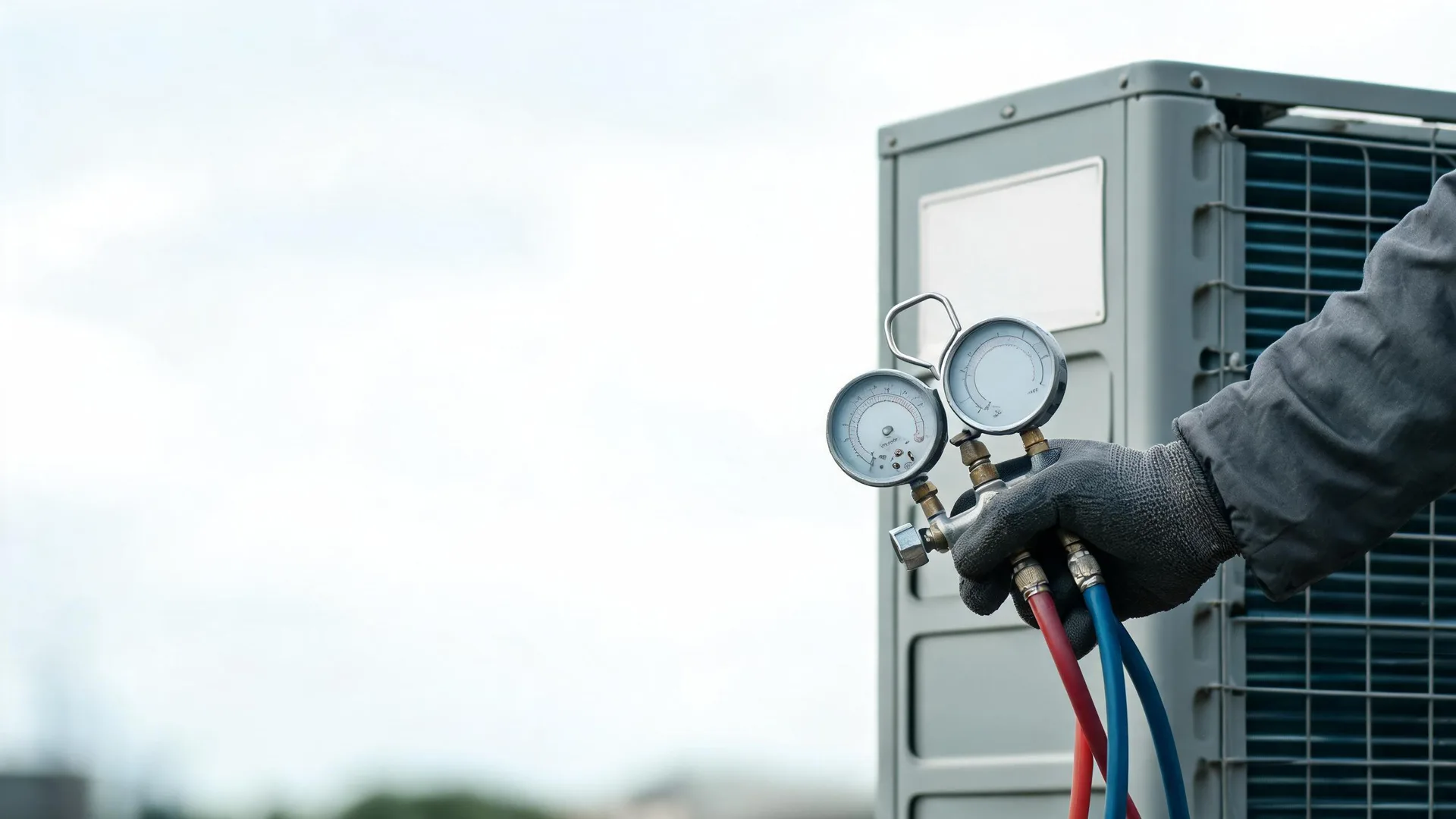
A diagnostic visit starts with questions, not tools. What is the system doing, when did it start, does it happen in heating mode or cooling mode or both. Then the tech checks the thermostat call and confirms the system is actually getting the signal to run. Gauges go on next to check refrigerant pressure, since that points to a leak or a charge issue right away. The electrical side gets checked too, the capacitor, the contactor, the wiring at the outdoor unit, because a part can test fine by eye and still be failing under load. If the reversing valve is suspect, the tech checks that it's actually shifting when it gets the signal to, not just that it hums. Airflow gets checked on both ends, the filter, the blower, the outdoor coil, since restricted airflow can mimic other problems that have nothing to do with the compressor. The point of the visit is to find which part is actually failing before anything gets replaced, since swapping parts without knowing that doesn't fix anything.