Heat pump stuck on emergency heat in Lake Charles, LA

RepairHeat PumpCalcasieu Parish, LA
Step 1 of 2

What ZIP code is the job in?

Emergency heat means the heat pump has stopped moving heat from outside and switched to backup resistance coils instead, the same ones that kick on when the outdoor unit ices over badly. If your system is stuck there on its own, with nobody flipping that switch on the thermostat, it usually means the outdoor unit isn't running, or the thermostat thinks it shouldn't. A failed outdoor fan motor, a tripped breaker to the condenser, a bad defrost control, or a thermostat wired or set wrong can all cause it. Lake Charles winters are mild, so this won't leave you without heat, but it does mean you're running on electric resistance heat full time instead of the heat pump doing the efficient part of the job. That backup heat costs more to run than the heat pump itself, every hour it stays stuck that way.

A woman with wavy blonde hair wearing a grey knit cardigan over a green top sits on a sofa in a living room, looking off to the side.
A woman with long brown hair in a cream knit sweater sits on a light sofa in a living room, looking toward a window with sunlight on her face.
A woman in a gray sweater sits in a chair in a living room with a dark sofa, wooden coffee table with a potted plant, and a staircase behind her, looking toward a window.
A smiling woman with dark hair in an updo, wearing a gray ribbed turtleneck sweater, sits on a light sofa in a living room and looks off to the side.

So why does your heat pump keep landing on emergency heat?

  • Winter nights average 44°F

    Winter nights average 44°F. That's cold enough for a struggling outdoor unit to lose the fight and fall back on the coils instead of fixing itself by morning.

  • Heat runs November through March

    Heat runs November through March. Five months is a long stretch to run on backup resistance heat, and it shows up on the bill fast.

  • Cooling runs April through October

    Cooling runs April through October. The same outdoor unit works most of the year, so a part that's wearing out has had plenty of chances to fail.

NOAA nClimDiv 1991-2020

A gray outdoor heat pump unit on a concrete pad beside a house with gray horizontal siding, with conduit and an electrical box on the wall and a shrub at left.

Thermostat switch left on emergency

Most thermostats have a separate setting for emergency heat, and it stays wherever it was last put. If someone switched it over during a cold snap or a repair and never switched it back, the system will run on the coils until someone moves that switch again. Check the thermostat first. If it reads "emergency heat" or "EM HEAT" and you can clear it by pressing a button or turning a dial, that's the whole problem, and the outdoor unit was never at fault.

An outdoor air-source heat pump unit with a dark grille stands on a concrete pad beside a white wall and wood-clad facade, surrounded by gravel.

Outdoor unit not responding

If the thermostat is set normally and the system still won't pull heat from outside, the outdoor unit itself isn't answering. That can mean the compressor isn't starting, the reversing valve is stuck, or the unit lost power on its own circuit even though the indoor coils still have power. In this case the switch didn't cause anything. It's a sign something outside has failed, and the coils are carrying the whole house until that gets fixed.

Why is the electric bill suddenly so much higher

Resistance coils cost more to run than the heat pump moving heat the normal way, and you'll see it on the bill that covers whatever stretch it ran stuck on emergency heat. You might also notice the air coming out of the vents feels different, hotter at the register but slower to actually warm the room, since the coils heat in bursts rather than the steady output the heat pump gives you. If this goes unnoticed through a cold week, the people in the house stay warm, but it costs more to keep them that way, and the outdoor unit still isn't doing the job it's supposed to be doing.

A gray outdoor heat pump unit on a concrete pad beside a house with horizontal lap siding, with a conduit running to a wall-mounted disconnect box and a green shrub to the left.

Running the way it should

This is a heat pump doing its job. It pulls heat from the outside air, even on a cool Lake Charles night, and moves it inside without the coils ever kicking on. The disconnect box and clean lines mean nothing is fighting it.

An outdoor air conditioning condenser unit with dusty coils sits on a concrete pad against light horizontal siding, with an electrical disconnect box and refrigerant lines on the wall and a shrub and mulch at left.

Stuck on backup heat

Years of grime on the coil and lines left to sit make it harder for a unit to pull heat from the air outside. When it can't keep up, it falls back on the electric coils and stays there until something changes. That's the bill you notice in January.

Leave It Or Get It Fixed

Leave it on emergency heat

  • The resistance coils will keep the house warm no matter how cold it gets outside, even in the low 40s overnight.
  • Your electric bill keeps climbing for as long as it runs this way, since the coils use far more power than the heat pump's normal cycle.
  • Whatever caused the switch, a frozen outdoor unit, a bad sensor, a thermostat stuck in the wrong mode, stays unresolved.
  • If the outdoor unit is icing over, it keeps icing over every cold night until someone looks at it.
  • You're not without heat while you wait, which matters if nights are in the 40s and you've got someone at home who feels the cold.

Get it looked at

  • A contractor can tell you in one visit whether it's the thermostat setting, a frozen coil, or a failed part sending the system into emergency heat.
  • Once the actual cause is fixed, the heat pump goes back to moving heat the normal way and the bill comes back down.
  • If it's ice on the outdoor unit, someone needs to find out why it's not defrosting on its own before another cold night hits.
  • A thermostat left in the wrong mode is a fast fix once someone's there to check it and switch it back.
  • You stop watching the thermostat and wondering if it'll hold through the next cold snap.
An outdoor condenser unit beside a horizontally sided house, encased in thick ice with hanging icicles, on a snow-dusted ground at sunset with bare trees in the background.

Just after six, the yard is still gray and the grass has a frost on it that won't last past eight. You go out to check the unit before leaving for work and see it coated in ice, thick along the coils and down over the fan guard, more than you'd expect for a night that only got into the low 40s. Inside, the thermostat reads a steady 70, the air coming out of the vents warm but not quite like it usually feels. You crouch by the outdoor unit a minute, looking for the usual drip and steam that means it's thawing itself out. There's none. It's just sitting there, iced over, in the quiet of the side yard.

Get the right pro for your heat pump

Send the request today and stop worrying about who to call.

No fee to send it, and nothing to sign.

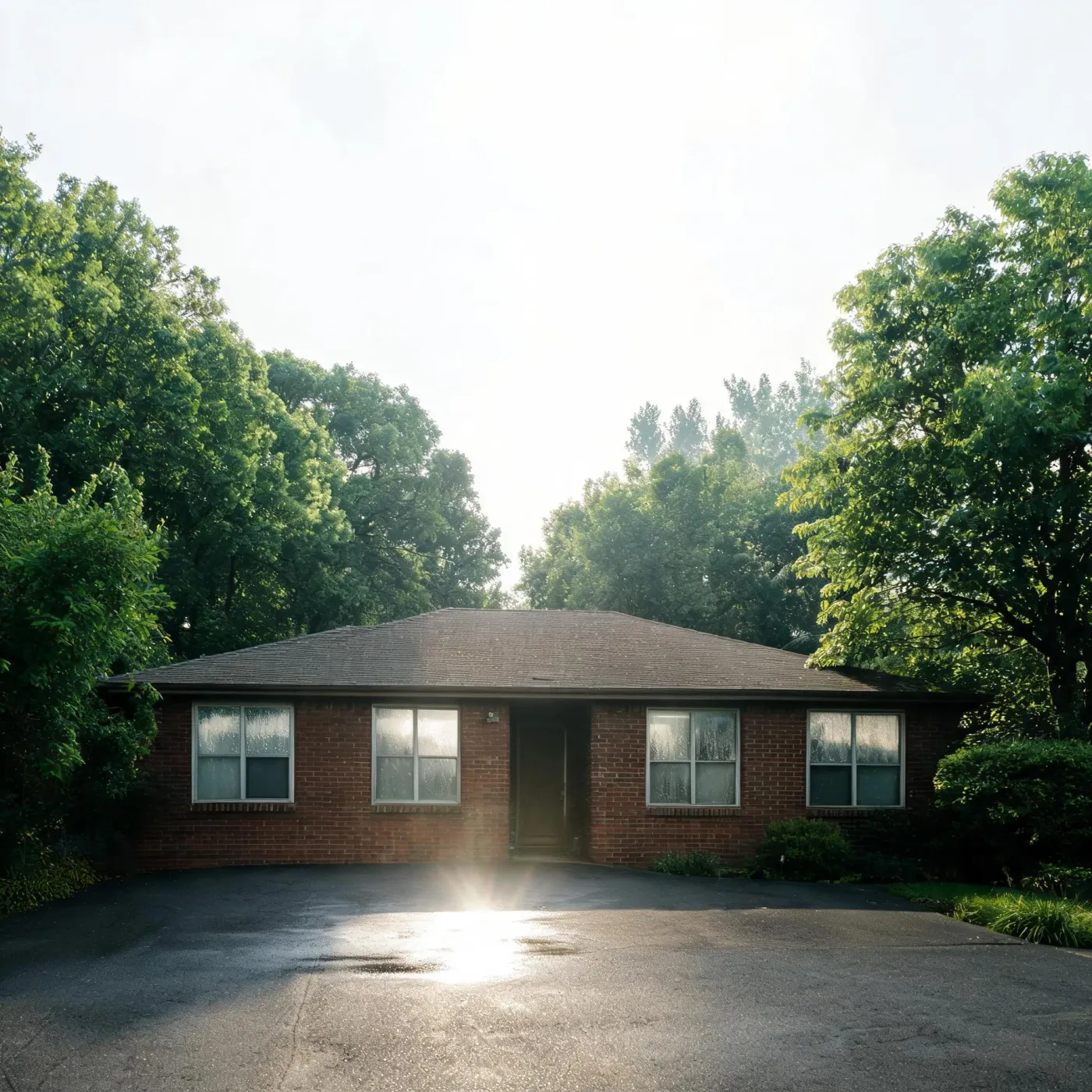
A single-story red brick house with a dark shingled hip roof, central door and four windows, fronted by a wide asphalt driveway and flanked by leafy green trees under a bright hazy sky.

The dew point here averages 74°F across June, July and August, which is the kind of air that feels wet even standing still. A heat pump doesn't care about that when it's cooling, but the same outdoor coil has to deal with it come winter, when that moisture in the air is part of what frosts it over on a cold night. Heavier ice takes the unit longer to clear on its own, and a system that can't clear it will drop to the coils and stay there. If yours is stuck on emergency heat, this is part of why the air here gives it more to fight than drier places would.

NASA POWER T2MDEW

What's the defrost board got to do with it?

You've heard it can be a bad sensor or the thermostat switch, but you also keep hearing about a defrost board, and nobody's explained what that part actually does or why it would leave your system stuck running on the coils instead of the heat pump.

It controls when the unit defrosts, and gets that wrong

The defrost board reads a sensor on the outdoor coil and decides when the unit needs to go into defrost to melt off ice, then decides when to come back out of it. If that board misreads the sensor or fails to end the defrost cycle the way it should, the system can get stuck believing it's still defrosting, or that it needs to defrost constantly. Either way it keeps leaning on the backup coils instead of switching back to the heat pump doing the work the normal way. On a night in the 40s, a bad board can hold the system in that state for hours, long after the ice outside is gone and the heat pump is ready to run again on its own.

A gray outdoor condenser unit on a concrete pad beside a house with horizontal lap siding, with a wall-mounted disconnect box, conduit and insulated refrigerant lines, a shrub at left and gravel at right.
Running normal, the outdoor unit sits quiet on its pad, lines and conduit doing their job with nothing iced over.
An outdoor air conditioning condenser unit on a concrete pad beside a house with horizontal lap siding, with a green shrub to the left and a wide concrete slab in the foreground.
Stuck on emergency heat, that same unit outside can look fine while the coils inside burn power nonstop to cover for it.
  1. Outdoor coil frosts over and the defrost board calls for a cycle.

  2. The board reverses the valve and runs hot gas to melt the ice.

  3. A sensor should tell the board when the coil is clear again.

  4. If that signal never comes, the board keeps the heat pump locked out.

A smiling older woman with gray hair in a loose bun wearing a ribbed beige sweater stands in a dimly lit kitchen beside a window showing darkness outside, with a loaf of crusty bread on a wooden board in the foreground.
A woman with dark hair in a bun sits on a sofa with a child resting his head on her shoulder, both wrapped in a cream knit blanket, with a lit lamp and bookshelf in the dim background.

Power here costs 12.95 cents per kilowatt-hour

At 12.95 cents a kilowatt-hour, running the coils instead of the heat pump adds up fast, since resistance heat pulls far more power to put out the same warmth. A system stuck on emergency heat for even a few days will show up clearly on your next bill.

EIA-861 2025

What this comes down to

  • Emergency heat that stays on by itself means a sensor, defrost board or reversing valve isn't doing its job, not something you caused.
  • A stuck defrost cycle or a bad sensor won't clear up on its own no matter how many mild days pass in a row.
  • Every day it runs this way, the coils are covering for a heat pump that should be doing the work on far less power.
  • A licensed contractor can check the defrost board, the sensor and the switch and get the heat pump moving heat again instead of just making it.
  • Sending the form is the last step on your end; from there, finding someone to look at it is off your plate.
  • The fix is usually a specific part, not a new system, once someone's traced it back to what's actually failing.

A heat pump that won't come off emergency heat on its own has a part that isn't doing its job. Most often it traces back to the defrost board, a sensor that never tells it the coil cleared, or a reversing valve that's stuck where it shouldn't be. None of that fixes itself. You can wait for a stretch of warmer days and it'll still be stuck there, because the problem isn't the cold, it's the part that's supposed to respond to it. In the meantime the resistance coils are carrying the whole load, pulling far more power than the heat pump needs to move the same warmth, and that shows up on the next bill whether the weather cooperates or not. None of this means the system is done or that a repair has to turn into a replacement. Once a licensed contractor gets eyes on the defrost board, the sensor and the switch, it's usually one part that's failing, not the whole unit. Sending the form is the only part of this left for you to do. After that, tracking down someone who can get out there and look at it stops being something you have to manage. The heat pump getting back to doing its actual job, pulling heat from the outside air instead of just backing it up with coils, starts with that one step.

Dark metal roofs and a stone chimney of a house seen from above, framed by moss-draped trees, with forested hills and hazy mountains under a cloudy sky in the background.

A pro who works on heat pumps

Let a pro reach out

Sending the form costs nothing.

A heat pump stuck on emergency heat won't fix itself, and every day it runs that way costs more than the day before. Send the request and let a contractor who knows these systems take it from here.