


An outdoor HVAC condensing unit on a concrete pad next to a beige single-story house with a dark shingle roof.

Heat Pump Repair in New Orleans, LA

Tell us about the job

Takes about a minute. No obligation.

RepairHeat PumpOrleans Parish, LA
Step 1 of 2

What ZIP code is the job in?

April is when the heat pump switches over to cooling after months of carrying the heat load alone, and that first stretch of real heat is when a weak part finally gives out. A capacitor or contactor that was already marginal in March often won't make it through the first hot week in April. Same thing in November, when the system switches back to heat after sitting idle since March. If yours is struggling right at the start of a season, that's not bad luck. That's the extra strain finding the part that was already close to done.

5 months
November through March, your system heats
7 months
April through October, it cools
46°F
the average winter night it heats against
90°F
the average summer afternoon it cools against
Isometric illustration of a cutaway single-story house showing interior ductwork and an air handler connected by lines to an outdoor condenser unit on a pad beside the building.
Your system heats November through March and cools April through October.

NOAA nClimDiv, 1991–2020 normals

Half the homes in Orleans Parish were built in 1960 or earlier.

A heat pump that came with a house that age is likely old itself, and worth asking a contractor how much life it has left.

Get it looked at early

Problems tend to show up in the first weeks of the season, when the load hits a part that was already weak.

Find a contractor
A gray outdoor HVAC unit mounted on a concrete pad beside a house with gray lap siding and a stone foundation.

Why it's worse to let it run

A heat pump that's struggling doesn't fix itself by staying on. If it's low on refrigerant, the compressor keeps trying to move a full load with less than it needs, and that raises its temperature every minute it runs. Run it long enough in that state and you're not looking at a repair anymore, you're looking at a compressor replacement. A failing capacitor is the same story. It makes the motor work harder to start and harder to keep turning, and every cycle after it starts slipping brings the motor closer to burning out. Ice on the outdoor coil is another one people leave alone because the system still blows air. But ice blocks the airflow the coil needs to do its job, so the system runs longer to make up for it, which pulls in more moisture, which builds more ice. None of these get better with time. They get better when someone shuts the system off and finds the part that's actually failing.

What you can check yourself

Look at the outdoor unit first. If the fan isn't spinning or the coil is caked in ice, that's worth noting before anyone comes out. Check the thermostat batteries and make sure it's set to the mode you want, heat or cool, since a thermostat stuck in the wrong mode looks exactly like a broken system. Walk through the house and check that vents are open and not blocked by furniture or rugs. Check the breaker box for a tripped breaker. None of this fixes a refrigerant leak or a bad compressor, but it rules out the simple stuff first.
What to leave alone

Don't take the outdoor panels off or touch anything inside the unit. There's a capacitor in there that holds a charge even when the power is off. Don't try to chip ice off the coil either, since that can bend the fins or crack the coil. If the system is making a grinding or screeching noise, turn it off at the thermostat rather than let it keep running. Running a system with a failing part doesn't buy you time, it just lets that part finish failing.

A heat pump fails the same handful of ways regardless of where it sits. The reversing valve is the part unique to a heat pump, and when it sticks, the system gets stuck heating when you want cooling or the other way around. Refrigerant leaks show up slowly, usually at a fitting or a coil, and the system loses capacity bit by bit rather than all at once. Capacitors and contactors wear out from the plain fact of cycling on and off thousands of times a year, and they tend to go at the start of a season when the system first has to work hard. The outdoor fan motor can seize or its bearings can go, and a compressor that's been running low on charge or short-cycling on a bad capacitor eventually wears out from the strain those problems put on it. Most failures trace back to one of these, not to the unit simply being old.

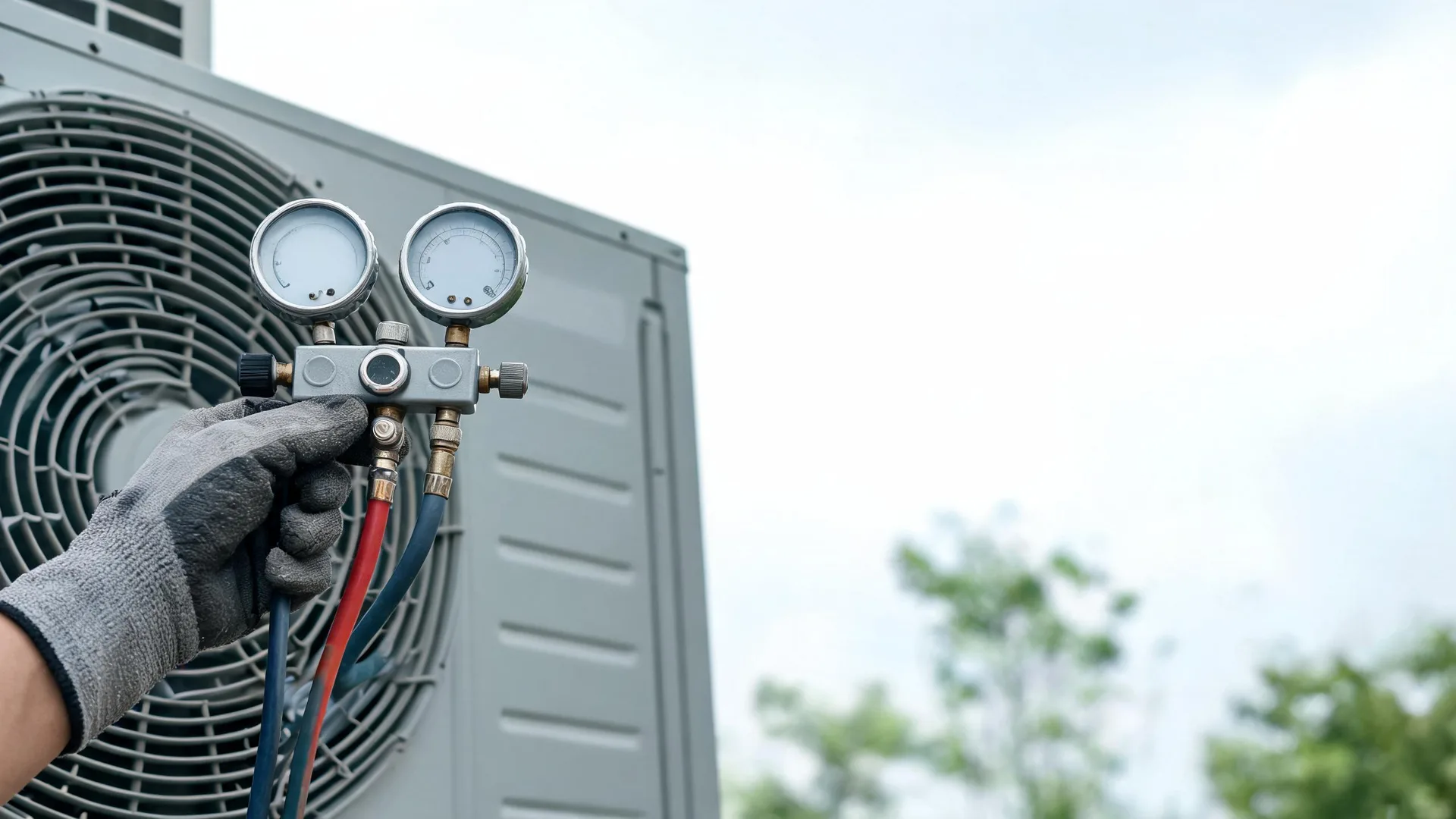
A diagnostic visit starts outside, at the unit itself. A tech will check the refrigerant charge with gauges, since both too little and too much throw off how the system heats and cools. They'll test the capacitor and contactor with a meter rather than guess from how they look, because a capacitor can read fine by eye and still be weak. They'll check the reversing valve to see if it's actually switching when it's told to, not just that it hums when powered. Inside, they'll check the airflow across the indoor coil, since weak airflow from a dirty filter or a blocked vent can mimic a refrigerant problem and send someone chasing the wrong fix. The point of all this is to find the one part that's actually failing, rather than replace parts that are still fine.