A row of single-story houses with porches, one brick and others with pale siding, behind a trimmed hedge and lawn, under oak branches draped with Spanish moss.

Heat Pump Repair in Morgan City, LA

Tell us about the job

Takes about a minute. No obligation.

RepairHeat PumpSt. Mary Parish, LA
Step 1 of 2

What ZIP code is the job in?

The tech checks the whole system, not just the symptom

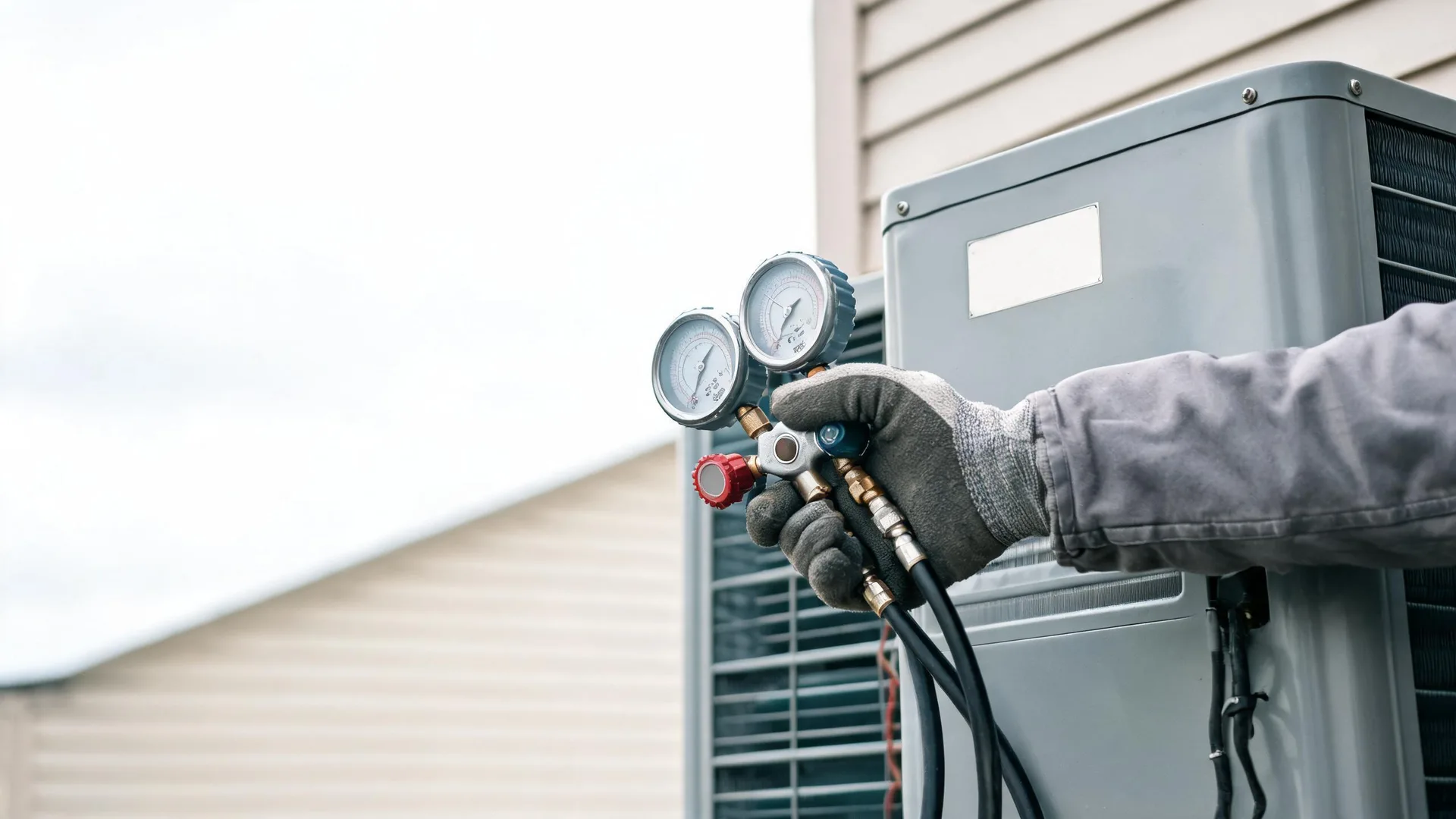
A heat pump that won't heat might have a problem on the outdoor unit, the indoor coil, the refrigerant charge, or the reversing valve that switches it between heating and cooling. The tech will check refrigerant pressures, test the compressor and fan motor, look at the defrost control board, and check airflow across both coils before saying what's wrong.


What they find decides what happens next

A failed capacitor or a stuck contactor is a straightforward fix on the spot. A refrigerant leak or a bad reversing valve takes more time to track down and repair. If the compressor itself has failed, the tech will walk through whether repairing it makes sense compared to replacing the unit.

5 months
November through March, your system heats
7 months
April through October, it cools
47°F
the average winter night it heats against
90°F
the average summer afternoon it cools against
Isometric line illustration of a cutaway single-story house showing interior rooms with ducted air distribution, an indoor air handler, furniture, and an outdoor condenser unit connected by lines outside the wall.
Your system heats November through March and cools April through October.

NOAA nClimDiv, 1991–2020 normals

A refrigerant leak makes the compressor work harder to move heat through the system.

Leave it running low on charge long enough and the compressor overheats, turning a leak repair into a compressor replacement.

Half these homes were built by 1976. That's not why your heat pump is struggling.

Half the homes here were built by 1976
Power costs 11.73 cents a kWh statewide
Climate zone 2A

Heat pumps here switch over to heat in November, so October is when a weak part gets tested for the first time all year. A reversing valve or a defrost control board that never had to work hard can fail the first cold morning it has to pull heat out of cold air instead of pushing it out. The same thing happens in April, when cooling starts up again and a compressor that's been sitting idle all winter has to kick on under full load. Either month is a good time to have it looked at, before the part that's already weak gets asked to carry the season.

Get the usual fix

Nothing about this area is especially hard on it. It's most likely the usual problem with the usual fix.

Find a contractor
A man in a gray shirt and tan pants carries a worn canvas tool bag up porch steps toward a dark blue paneled front door, with a potted shrub beside the entry.
A residential heat pump outdoor unit mounted on a concrete pad next to a house with gray vinyl siding.

What to check before you call

Before anything else, check the thermostat is set to heat and the temperature is set above room temperature. Check the outdoor unit isn't buried in debris or iced over. A heat pump can run defrost cycles in cold weather, so some frost is normal, but a solid sheet of ice across the coil is not. Go to the breaker panel and check nothing has tripped, both the indoor air handler and the outdoor unit usually run on separate breakers. Check the air filter. A clogged filter starves the indoor coil of airflow, and a heat pump that can't move air can't move heat either. Walk through the house and check that supply vents are open and not blocked by furniture or rugs. If the outdoor fan isn't spinning at all, or you hear the compressor humming but nothing moves, that's not something to force or troubleshoot further. Shut it down at the thermostat and let a tech take it from there.

Capacitors and contactors wear out on a schedule

The run capacitor gives the compressor and fan motors their starting push. It weakens with every cycle until it can't do the job anymore. The contactor that feeds power to the outdoor unit pits and burns from arcing each time it closes. Both are wear parts on any heat pump. Both tend to fail from age rather than from anything going wrong with the rest of the system.

Moving parts fail differently than electronic ones

A fan motor or compressor usually gives some warning. It runs louder, pulls harder, or cycles off on its own before it quits for good. A circuit board or sensor doesn't work that way. It runs fine, then it doesn't, often after a power spike or years of heat inside the cabinet. Knowing which kind of part failed changes whether the fix happens on the spot or waits on a part to come in.

Most people don't notice a heat pump problem until the air coming out feels wrong. Warm air that isn't warm enough, in heating mode, is one of the first things people pick up on. So is the system running constantly without ever satisfying the thermostat. Short cycling is another one, where the unit kicks on, runs a few minutes, and shuts off again before the house has caught up. A hissing or bubbling sound near the lines points at refrigerant. A burning smell or a breaker that keeps tripping means stop running it and get it looked at rather than waiting. Ice building up on the outdoor coil that never clears, even after the system has had time to run its defrost cycle, is a sign something in that cycle isn't working right.

A heat pump lives or dies by its compressor. That's the expensive part, and a failed one is usually what ends a system rather than starts a repair bill. If the compressor is still good, a capacitor, a contactor, a fan motor, even a reversing valve, those are parts a tech can replace on their own without touching anything else. The harder call comes when the compressor itself is failing or the coil is leaking refrigerant in more than one spot. At that point you're not fixing a part anymore, you're paying to keep an old system limping along next to a new one that would just work. A tech who's checked the whole system can tell you which situation you're actually in before you decide anything.