






An unfinished basement featuring a grey forced-air furnace with metal ductwork, concrete block walls, exposed wooden joists, and a single hanging bare bulb.

Furnace Repair in Opelousas, LA

Tell us about the job

Takes about a minute. No obligation.

RepairFurnace or heatingSt. Landry Parish, LA
Step 1 of 2

What ZIP code is the job in?

A tech starts by asking what the furnace is doing, or not doing, before touching anything. Short cycling, no heat, a burning smell, a blower that won't shut off, each of those points down a different path. Next comes a look at the thermostat settings and the air filter, since a clogged filter can choke airflow and cause problems that look electrical but aren't. From there the tech opens the cabinet and checks the igniter or pilot, the flame sensor, and the gas valve, watching the burners light and settle. They'll check the blower motor and capacitor, and pull a reading on the limit switch to make sure the furnace isn't overheating and shutting itself off as a safety measure. By the end they can usually point to the one part that's failing and explain what replacing it involves.

5 months
November through March, your furnace is on duty
43°F
the average winter night it heats against
2 winter storms
in ten years, the nights a failure hurts most
Isometric line illustration of a cutaway building interior showing a furnace unit with a flue pipe and ductwork running along the ceiling, plus adjacent rooms with simplified furniture.
Your furnace works hardest from December through February.

NOAA nClimDiv, 1991–2020 normals

Half the homes in St. Landry Parish were built in 1980 or earlier.

A furnace in a house that age fails for the same handful of reasons a new one does, so the diagnosis still starts with the igniter and the flame sensor.

Five months of mild winter nights is a light workload for a furnace

Heat runs November through March
Winter nights average 43°F
Climate zone 2A

A furnace that's struggling doesn't fail quietly. A cracked heat exchanger left alone can push exhaust into the air stream instead of venting it outside. A flame sensor that's barely reading right will make the gas valve cycle the burners on and off, and each restart puts more strain on the igniter until it cracks. A blower motor running on a weak capacitor draws more current trying to spin up, and that extra heat breaks the motor down faster than normal use would. Even a clogged filter left in place makes the furnace run hotter and longer to push out the same heat, which is exactly what trips a limit switch. None of that gets better by waiting. The part that's struggling now usually fails on its own terms. Left running, it tends to take something else down with it.

Get the usual fix

Nothing about this area is especially hard on it. It's most likely the usual problem with the usual fix.

Find a contractor
A man in a dark t-shirt and tan work pants, seen from behind, carries a worn canvas and leather tool bag up concrete steps toward a dark gray front door, with a potted flowering plant to the right.
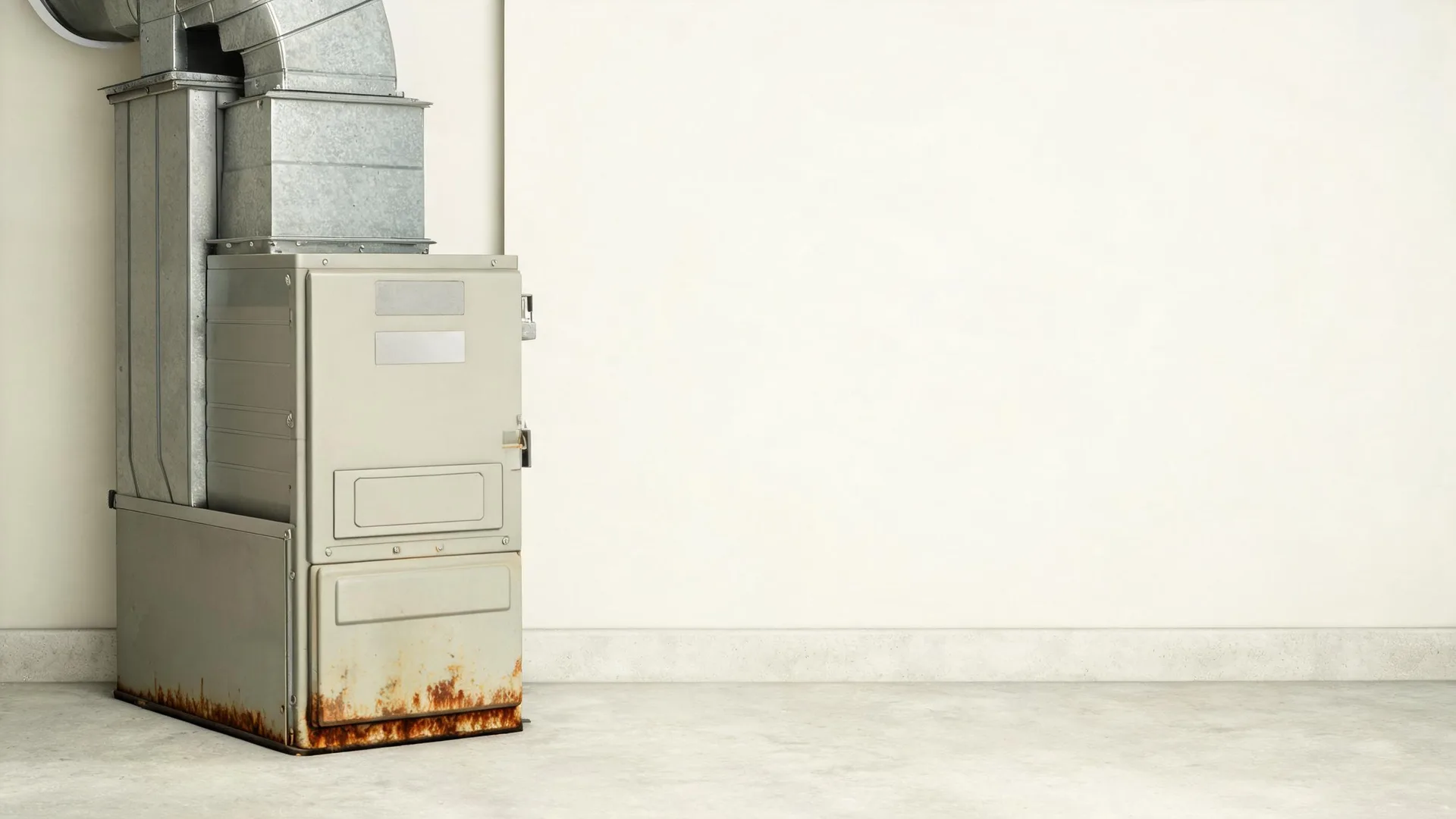
A gray residential gas furnace installed in an unfinished basement, surrounded by ductwork, a metal flue pipe, and a gas supply line.

A light workload means a repair is usually enough

A furnace that's run five mild winters without much strain usually has one part going bad, not a system falling apart. That's worth knowing before you decide whether to repair or replace. If the cabinet, blower and ducts are otherwise sound, fixing the igniter or whatever's failed is the straightforward call.

No heat, or heat that won't stop

A furnace that won't fire at all usually comes down to the igniter, the flame sensor, or the gas valve. A furnace that won't stop running, or cycles on and off every few minutes, points somewhere else. A dirty flame sensor can do it. So can a clogged filter choking off airflow, or a limit switch tripping because the furnace is running hotter than it should. What the furnace is actually doing tells a tech where to start before the cabinet even comes off.
Sounds and smells worth a call

A burning smell the first time the furnace runs after sitting idle usually just burns off dust and clears on its own. One that lingers, or shows up with smoke, means shut it off and get it looked at. A bang when the burners light means they're not lighting evenly, which points to the gas valve or the igniter. Grinding or squealing from the blower usually means the motor or capacitor is wearing out, and that doesn't get better on its own.

Most furnace failures trace back to a handful of parts that wear out doing their job over and over. The igniter sits in the flame path every time the furnace fires, and that repeated heating and cooling is exactly what eventually cracks it. The flame sensor picks up a coating of oxidation and soot over time and starts telling the gas valve to shut off even though the flame is burning fine. Capacitors lose their charge gradually, so a blower motor that used to start right up begins to hesitate or hum before it finally won't turn over at all. Limit switches and pressure switches rarely fail on their own, they're usually reacting to something else going on, a dirty filter, a blocked flue, a blower that's struggling. Age plays a part, but it's wear on these specific parts that ends a furnace's life, not the cabinet or the ductwork around it.

A furnace rarely fails all at once. One part goes, the rest of the system is still sound, and that's what makes the repair or replace decision fairly simple most of the time. Replacement starts to make sense when the heat exchanger cracks, since that's the one part that isn't practical or safe to fix on its own, or when a tech is called out for a second or third different failure within a short stretch and the pattern looks like a furnace that's wearing out all over rather than one weak part. Short of that, a cracked igniter or a failed capacitor is a straightforward fix on a furnace that's otherwise working the way it should. The cabinet, the ductwork, the blower housing, none of that wears out on a schedule, so there's no reason to replace a furnace just because it's had a part fail. Ask what's actually being replaced and why before agreeing to anything bigger than the repair in front of you.