





White two-story houses with wraparound porches and Spanish moss-draped oak trees photographed along a residential street at night.

Furnace Repair in Many, LA

Tell us about the job

Takes about a minute. No obligation.

RepairFurnace or heatingSabine Parish, LA
Step 1 of 2

What ZIP code is the job in?

Before you call anyone, check a few things yourself. Look at the thermostat first. Make sure it's set to heat and the set point is above room temperature, and swap the batteries if it uses them. Go to the breaker panel and check that the furnace breaker hasn't tripped. If you have a standing pilot, see if it's lit, and if it's gone out, the pilot light assembly may have instructions posted right on the furnace for relighting it. Check your filter too. A filter packed with dust chokes airflow and can cause the furnace to shut itself off as a safety measure. None of this takes long, and it rules out the simple stuff before anyone has to open the cabinet.

5 months
November through March, your furnace is on duty
39°F
the average winter night it heats against
3 winter storms
in ten years, the nights a failure hurts most
Isometric grayscale illustration of a cutaway house showing an interior furnace with a tall flue pipe and ductwork running to rooms under a partially lifted roof.
Your furnace works hardest from November through February.

NOAA nClimDiv, 1991–2020 normals

Half the homes in Sabine Parish were built in 1986 or earlier.

A furnace that's been through a few owners is more likely to need a part than a whole new unit, and a repair call is where you find out which.

Many's furnace season starts in November, and that first cold month is when weak parts give out

Heat runs November through March
Winter nights average 39°F
Climate zone 3A

Furnace here only has to work about five months a year, November through March. Overnight lows average 39°F through the worst of winter, which is cold enough to run the furnace steady but nothing close to what machines face further north. That's a shorter, easier season than most of the country asks of a furnace. So when one in Sabine Parish acts up, age or a neglected filter is more often the cause than the system being worn past its limit. A furnace that's had a mild working life is usually still worth repairing.

Storm damage to the furnace doesn't always show up right away

Sabine Parish has had 90 severe weather events between 2015 and 2024, and damaging wind or hail accounted for most of them. The furnace's outdoor parts sit right where hail and flying debris can reach them. A unit can take a hit and keep running for a while before it fails outright. If yours came through a storm, it's worth having someone look at it now instead of waiting for it to quit on a cold night.

Find a contractor
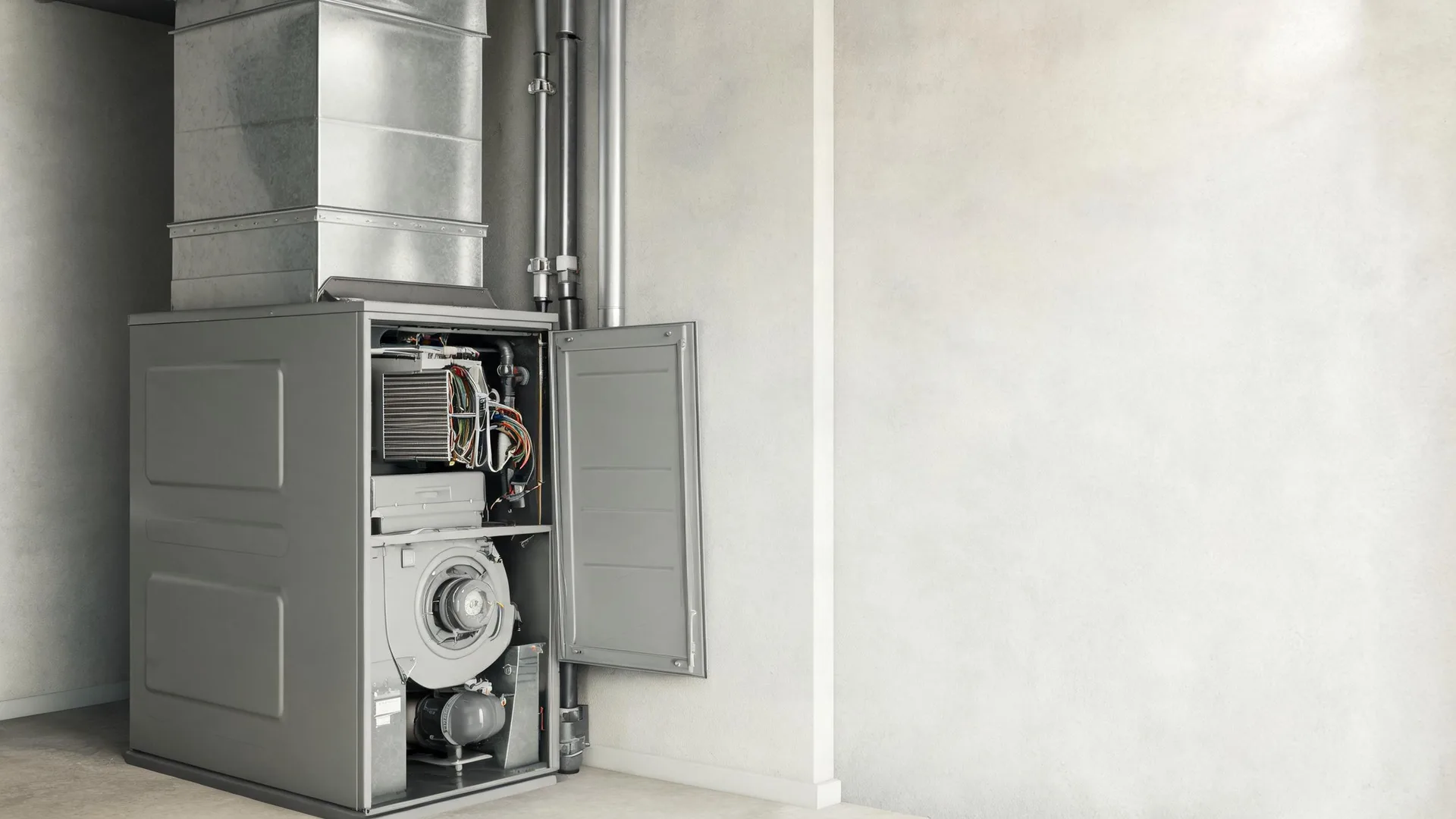
A gray high-efficiency gas furnace installed in an unfinished basement, surrounded by gas lines, a condensate drain, and sheet-metal ductwork.

Running a furnace with a known problem doesn't buy you time, it spends it

A furnace that's struggling doesn't fail quietly if you keep asking it to run. A cracked heat exchanger gets worse with heat cycles, not time sitting idle, so every time it fires it flexes that crack a little more. A dirty flame sensor left alone means more shutdowns and restarts, and each restart is wear the igniter didn't need. Weak airflow from a clogged filter makes the blower work harder and can run the heat exchanger hotter than it's built for. None of this fixes itself by waiting. The part that's already failing is the one doing the damage, and it keeps doing it every time the furnace turns on.

The igniter wears out from doing its job

Every heat cycle, the igniter heats up to light the gas. That heating and cooling is what eventually cracks a hot surface igniter or wears out the electrodes on a spark igniter. It's one of the most common reasons a furnace won't light at all, and it's a straightforward swap once it's confirmed.
A dirty flame sensor reads as no flame

The flame sensor checks that gas is actually burning once the igniter lights it. Soot builds up on the rod over time, and once it's coated enough, the sensor can't tell a flame is there even though one is. The furnace shuts the gas back off to stay safe, so it looks like it won't stay lit when the real problem is just a dirty rod.

A furnace usually tells you something is wrong before it quits for good. Short cycling is one of the clearest signs, where it fires up, runs a few minutes, and shuts off before the house warms at all. Cold air coming out of the vents instead of warm means the burners may not be lighting, even if the blower is running fine. A burner flame that looks yellow or flickering instead of steady blue is worth paying attention to, since that can point to a combustion problem rather than just a worn part. Banging or scraping when it starts up usually means something loose or worn inside the cabinet, not something that fixes itself. And if the furnace runs but the thermostat shows a temperature well below what it's set to, the system is struggling to keep up, which only gets worse the longer it's ignored.

A repair decision really comes down to what broke and what it's attached to. A blower motor, an igniter, a pressure switch, these fail on their own and get replaced on their own, and the rest of the furnace doesn't care how old it is. A cracked heat exchanger is different. That's the part that separates the flame from the air blowing through your house, and once it's cracked, it's not something anyone patches. Most contractors will tell you a repair makes sense when the furnace runs fine otherwise and this is just one part letting go. It stops making sense when you're looking at the second or third repair in a couple winters, because that pattern usually means more parts are close behind the one that just failed. A furnace that's been maintained, filter changed, burners cleaned, generally has an easier case for repair than one that's been ignored, simply because neglect tends to take out more than one part at a time.