




White two-story houses with wraparound porches and Spanish moss-draped oak trees photographed along a residential street at night.

Heat Pump Repair in St. Gabriel, LA

Tell us about the job

Takes about a minute. No obligation.

RepairHeat PumpIberville Parish, LA
Step 1 of 2

What ZIP code is the job in?

Half the homes in Iberville Parish were built in 1986 or earlier, and half in 1986 or later. That split doesn't point to any one cause of trouble. An older heat pump is more likely to need a new capacitor, a contactor, or a board that's finally given out. A newer one is more likely dealing with a bad sensor or a stuck reversing valve. Mobile homes make up about a fifth of the housing here, and those units often sit on a pad outside with a shorter line set, worth mentioning to the contractor if that's your setup. None of this points to a strange or rare failure. It's the same parts that wear out on any heat pump, and the fix is usually straightforward once someone's had a look.

5 months
November through March, your system heats
7 months
April through October, it cools
44°F
the average winter night it heats against
91°F
the average summer afternoon it cools against
Isometric cutaway illustration of a house showing interior ductwork, an indoor air handler unit, and an outdoor condenser unit beside the building.
Your system heats November through March and cools April through October.

NOAA nClimDiv, 1991–2020 normals

A heat pump that won't switch from heat to cool usually has a stuck reversing valve.

The reversing valve isn't something to force by flipping the thermostat back and forth. Leave it alone and let a contractor check it.

Nothing unusual about the weather hereIberville Parish saw 39 severe weather events between 2015 and 2024, mostly wind and hail, nothing a heat pump elsewhere doesn't also deal with.

October is the month before heat season starts here, and that's when a weak part tends to show itself, before the system has to carry a full load. A heat pump that's been cooling since April switches over to heat in November, and that reversal puts strain on the same valve and contacts that may have already been struggling by the end of last season. If yours was short-cycling or blowing cool air near the end of summer, that's worth having looked at now rather than waiting for the first cold night to find out it didn't make it. Heat runs here from November through March, so a problem caught in October gets fixed before you need the system every day.

Get the usual fix

Nothing about this area is especially hard on it. It's most likely the usual problem with the usual fix.

Find a contractor
A man in a cap, dark jacket and tan work pants carries a canvas tote bag as he steps up concrete stairs toward a blue front door, with a potted shrub beside him.
A gray air-source heat pump mounted on a concrete pad next to a house with gray vinyl siding, surrounded by gravel and flanked by green shrubs and white hydrangea flowers.

Why these parts fail

Most heat pump failures trace back to a handful of parts, and they fail for ordinary reasons. A capacitor weakens with every start it gives the compressor or fan motor, and eventually it can't deliver the kick needed, so the motor hums instead of starting. A contactor's contacts pit and burn from years of making and breaking the circuit, until they stick or stop conducting. Refrigerant doesn't wear out, but a fitting or coil can develop a slow leak over time, and once the charge drops the compressor strains to do its job. The reversing valve cycles every time the system switches between heat and cool, and that constant movement is exactly what wears out its seals and gets it stuck. Circuit boards fail from age, from moisture, or from a power surge they couldn't absorb. None of this is bad luck. It's what happens to parts that start and stop and switch for years without a break.

A small problem can turn into a bigger one

A heat pump low on charge will keep running, but the compressor works harder to move heat with less refrigerant than it needs. Run it that way for weeks and the compressor takes the damage, not just the charge. What started as a slow leak ends as a failed compressor.
Some signs mean stop, not wait

Ice building on the outdoor coil, a breaker that trips more than once, or a smell from the air handler are reasons to shut the system off and get someone out. Running a heat pump through those won't fix them, and it turns a repair into a replacement.

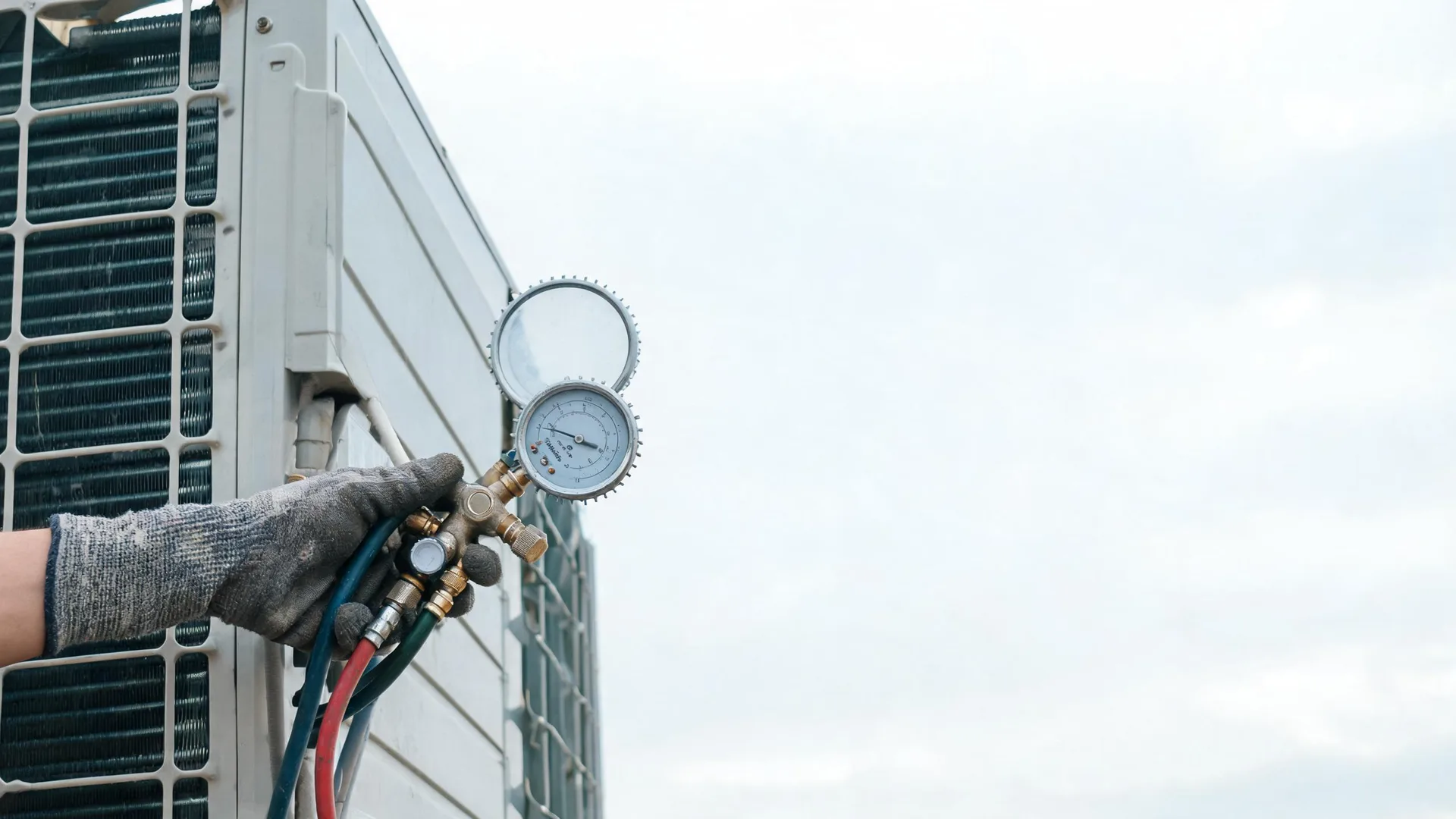
A diagnostic visit starts before the panels come off. The tech asks what the system is doing, when it started, and what you've noticed, whether that's a smell, a sound, or a room that won't get warm. Then it's gauges on the lines to check refrigerant pressure, a meter on the electrical components to see what's pulling the right current, and a look at the reversing valve and the contactor since those are common places for a heat pump to fail. Outside, the coil gets checked for ice or dirt that would block airflow. Inside, the tech checks the air handler and the return air for anything restricting flow, since a heat pump starved for air runs into the same trouble as one low on charge. Most of this is done with the system running, because a problem that only shows up under load won't show up with the power off.