






Single-story houses with beige siding and a brick building set on a mown lawn behind a trimmed hedge, framed by large oak branches draped with Spanish moss.

Heat Pump Repair in Opelousas, LA

Tell us about the job

Takes about a minute. No obligation.

RepairHeat PumpSt. Landry Parish, LA
Step 1 of 2

What ZIP code is the job in?

St. Landry Parish saw 79 severe weather events between 2015 and 2024. Damaging wind did most of that, and tornadoes touched down more than once in that stretch too. Your heat pump's outdoor unit sits outside through all of it, with coil fins and fan blades exposed to whatever blows through. Wind-driven debris can bend fins or nick a blade without stopping the system right away, so it keeps running while it loses efficiency. If a storm has come through since anyone last looked at the unit, that is worth checking even if the house still feels fine.

5 months
November through March, your system heats
7 months
April through October, it cools
43°F
the average winter night it heats against
91°F
the average summer afternoon it cools against
Isometric grayscale illustration of a cutaway house showing interior rooms, ceiling ductwork connected to an indoor air handler, and an outdoor condenser unit beside the exterior wall.
Your system heats November through March and cools April through October.

NOAA nClimDiv, 1991–2020 normals

A heat pump nearing the end of its working life tends to ask for a repair, then ask again not long after.

When that pattern shows up, a contractor can walk through repair cost against a new system and let you decide with real numbers instead of a guess.

November runs it hard right away, after it sat since March

Cooling runs April through October
Heat runs November through March
Power costs 11.73 cents a kWh statewide

A bent fin or a nicked blade won't always show up as a dead system. It shows up as a unit that runs longer than it should to keep up, or short cycles when it shouldn't. If nobody's looked at the outdoor unit since the last bad storm came through, ask for that specifically when a contractor comes out, not just a general check. Nearly half of Louisiana households lost power for a full day or more last year, and a heat pump that sat through an outage can come back running with a problem that was already there, just waiting to get noticed.

Get it checked after a storm

Storms hit hard here. If the outdoor unit took hail or debris, have it checked even if it still runs.

Find a contractor
A man in a cap, dark long-sleeved shirt and brown work pants walks up gray porch steps toward a dark blue front door, carrying a worn canvas tool bag filled with hand tools, with a potted shrub to the right.
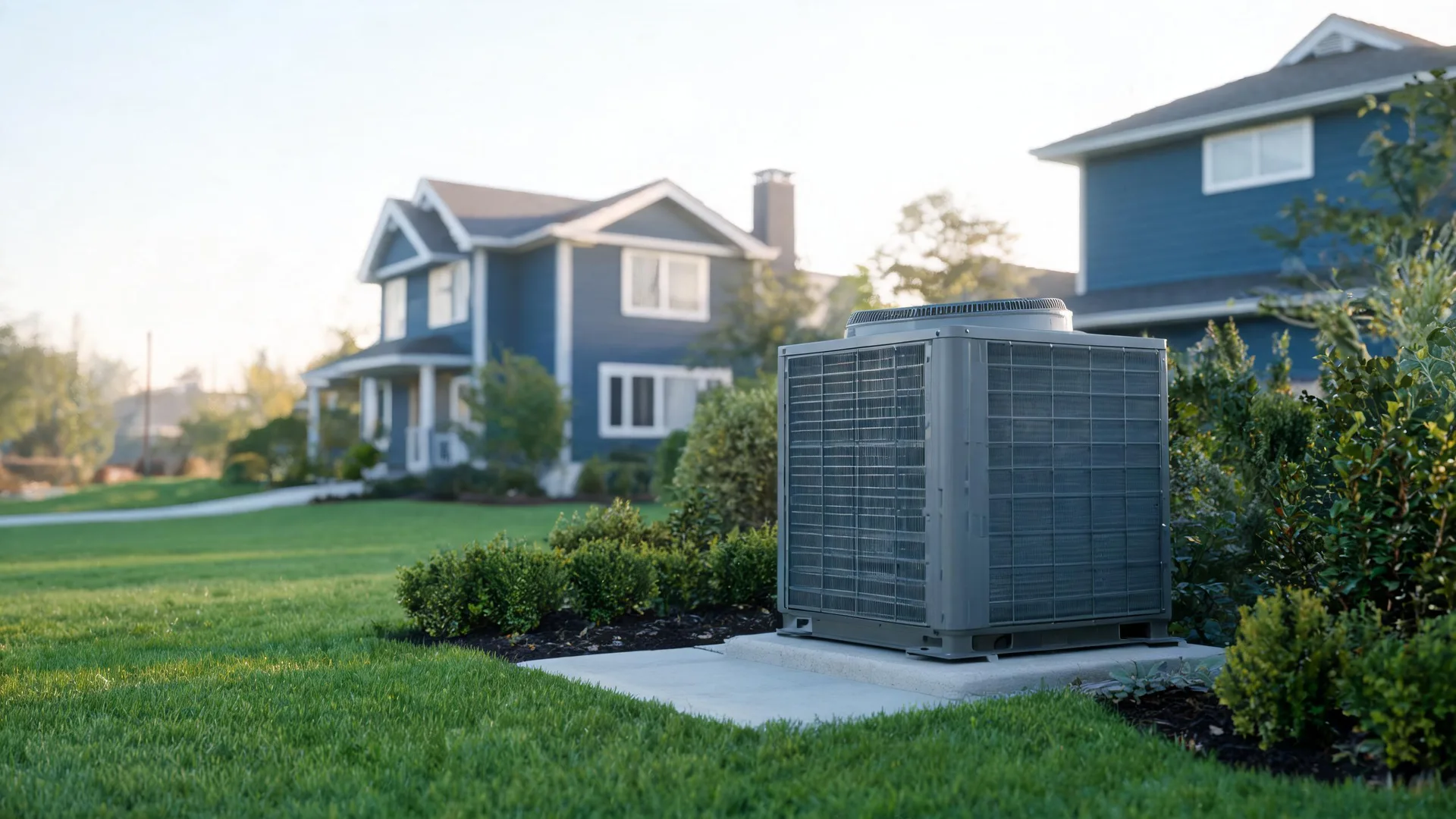
A dark gray heat pump unit mounted on a concrete pad next to a house with gray siding and a stone veneer wall.

Left alone, a small problem finds a way to become a big one

A heat pump that's struggling doesn't usually stop outright. It keeps running, just worse at the job, and that's how a small problem turns into a bigger one. A weak capacitor makes the compressor strain on every start instead of spinning up clean. A low refrigerant charge makes the system run longer to move the same amount of heat. Either one left alone pushes the compressor past what it was built for, and the compressor is the part nobody wants to see fail. Short cycling adds its own wear, since every restart is harder on the system than staying on would be. None of this announces itself. The unit keeps heating and cooling the house, a little worse each week, until the day it doesn't.

What you can check yourself

Look at the outdoor unit and clear anything piled against it, leaves, a fallen branch, grass clippings packed into the fins. Check that the panel covering the fan isn't dented in against the blade. Inside, swap the air filter if it's dirty and make sure every supply vent is open and unblocked. On the thermostat, confirm it's set to heat and the set point is actually above room temperature. If you've got a breaker box you know your way around, check that the breaker for the outdoor unit hasn't tripped.
What tells you to stop checking and call

If the outdoor fan isn't turning at all while the indoor side runs, or you hear grinding or a loud buzz from outside, that's a part failing, not a clog you can clear. Ice building up on the outdoor coil when it's not in defrost, a breaker that trips again right after you reset it, or a smell of something burning means stop and get a contractor out rather than keep resetting it yourself.

Most heat pump problems show up as a change in sound or rhythm before the system quits outright. A unit that used to click on and run steady but now short cycles, shutting off a few minutes after it starts, is struggling to finish a heating or cooling cycle. Warm air coming out of the vents when it's set to heat, or air that never feels quite cold enough in the other direction, points to the system working but not moving enough heat either way. A hissing sound near the lines or ice on the outdoor coil when it isn't defrosting usually means refrigerant is low, and that's not something that tops itself off. If the outdoor unit hums but the fan doesn't spin, or the whole system trips its breaker more than once, something inside has already failed rather than just gotten dirty.

A diagnostic visit starts outside, at the unit itself, before anything gets taken apart. A contractor checks refrigerant pressure on both the high and low side. That reading alone points toward a leak, a bad metering device, or a compressor that's losing its ability to move heat. Electrical testing comes next. The capacitor gets checked under load, not just by looks, because a capacitor can read fine sitting still and still fail to kick the compressor on. Amp draw on the compressor and on both fan motors tells its own story, since a motor pulling more current than it should is a motor on its way out. Airflow gets checked too, across the indoor coil and through the ducts, because a system can have good refrigerant and good electrical and still perform poorly if air isn't moving through it right. The reversing valve gets tested on a heat pump specifically, since that's the part that switches it between heating and cooling, and a valve stuck partway can mimic other problems. None of this takes guessing. Each test either rules something out or points straight at what failed.