



An outdoor HVAC condensing unit on a concrete pad next to a beige single-story house with a dark shingle roof.

Heat Pump Repair in New Iberia, LA

Tell us about the job

Takes about a minute. No obligation.

RepairHeat PumpIberia Parish, LA
Step 1 of 2

What ZIP code is the job in?

Iberia Parish sees its share of rough weather, 40 severe events logged between 2015 and 2024, most of it wind. None of that points to anything unusual going on inside your heat pump. Wind and storms put stress on the outdoor unit and the power feeding it, not on some weak point specific to this area. When a heat pump here needs repair, it's almost always the same handful of things that go wrong on any heat pump. A failing capacitor. A low refrigerant charge. A dirty coil. A stuck reversing valve. If the power just came back on after an outage, check the breaker and the outdoor disconnect before anything else. Beyond that, treat it like the ordinary repair it probably is.

5 months
November through March, your system heats
7 months
April through October, it cools
46°F
the average winter night it heats against
90°F
the average summer afternoon it cools against
Isometric illustration of a cutaway single-story house showing interior ductwork and an air handler connected by lines to an outdoor condenser unit on a pad beside the building.
Your system heats November through March and cools April through October.

NOAA nClimDiv, 1991–2020 normals

A heat pump that keeps running with a low charge pulls the compressor down with it.

Shut it off and call for repair, and a swapped valve or capacitor is the whole job.

An older parish, but not a harder one on your heat pumpHalf the homes here were built in 1982 or earlier, and almost one in five is a mobile home.

November through March is heat here, April through October is cooling, so March and October are the only months this system gets a break. That's not about the parish being hard on it. It's just a long runtime either way you look at it. A capacitor or reversing valve that was already marginal going into October often doesn't wait for the next slow stretch to fail. It gives out right as the load shifts, in November when heat kicks on or in April when cooling starts back up. If something's acting up right at that turn, that's what's happening. Worth getting looked at before the rest of the season leans on it.

Get the usual fix

Nothing about this area is especially hard on it. It's most likely the usual problem with the usual fix.

Find a contractor
A gray outdoor HVAC unit mounted on a concrete pad beside a house with gray lap siding and a stone foundation.

The hours add up whether you notice them or not

A heat pump doesn't get a season off to recover. It switches between heating and cooling and back, and every switch puts the reversing valve to work. Run hours add up the same way miles do on a car, and the parts most exposed to that wear show it in specific ways. A compressor that's been struggling sounds different, a low hum or a hard start where it used to kick on clean. A reversing valve that's sticking shows up as the system blowing cold when it should blow warm, or running in the wrong mode until you force it to switch. Short cycling, where it kicks on and off every few minutes instead of running a full cycle, points to a failing capacitor or a thermostat sensor that's lost its accuracy. None of these are signs to wait out. A system that's struggling and still running is putting more hours on the exact parts that are already worn.

What you can check safely

Look at the outdoor unit and clear anything packed against it, leaves, grass clippings, a stray branch. Check the thermostat is set to heat or cool as you mean it to be and the batteries aren't dead. Go to the breaker panel and look for a tripped breaker. Check the filter and swap it if it's gray or clogged. These take a few minutes and rule out the simplest causes before anyone opens up the unit.
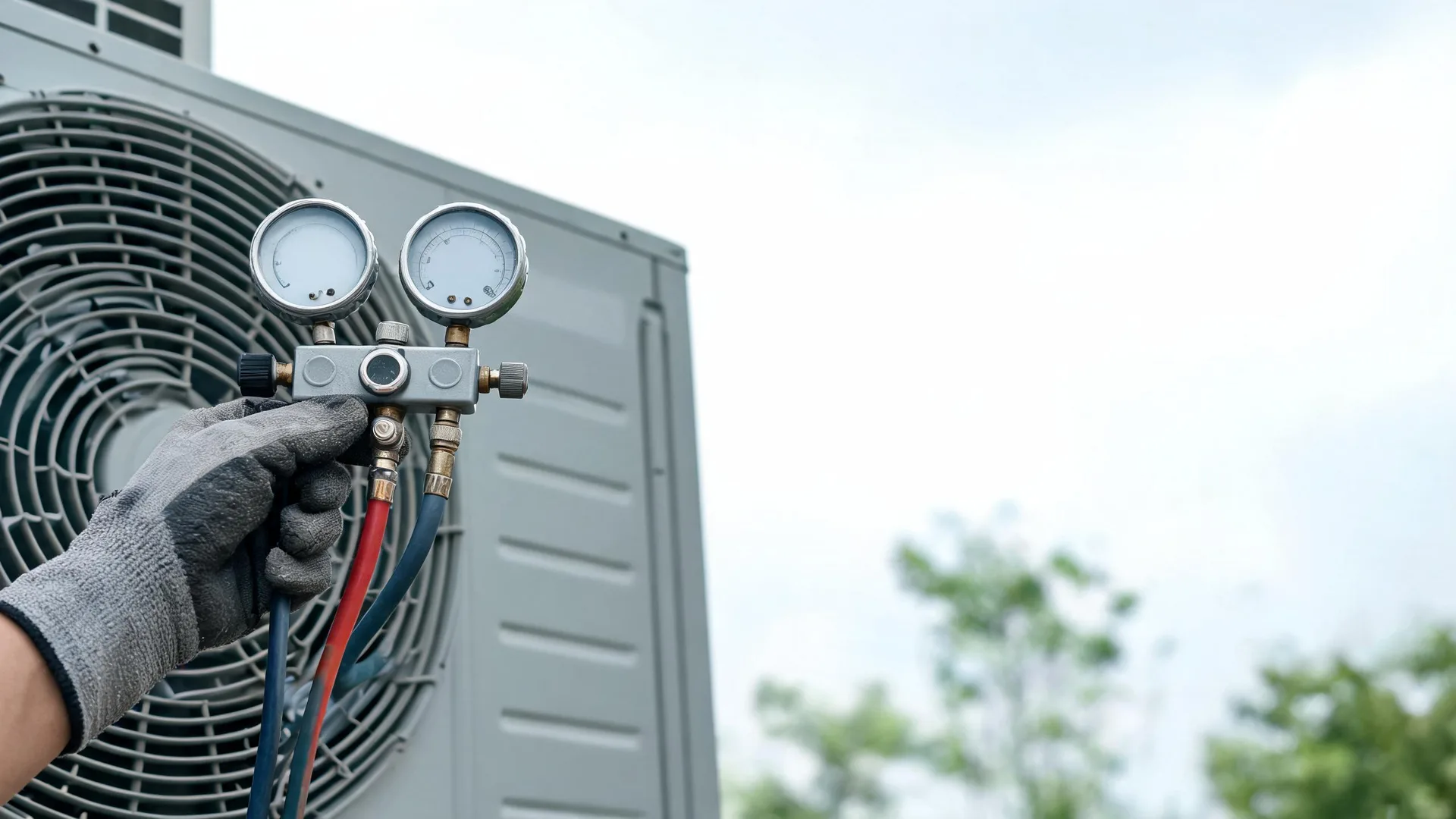
What to leave alone

Don't pull the access panel or touch the wiring inside the outdoor unit. Don't add refrigerant or try to find a leak yourself, that takes gauges and training to do safely. If the system is icing over, turn it off and let it thaw rather than running it harder. Anything past the thermostat and the breaker is a job for someone who works on these for a living.

Most of the time, repair is the right call. A heat pump is built from parts that fail one at a time, not all at once, and swapping out a capacitor or a reversing valve brings the whole system back to normal. Replacement starts to make sense when the compressor itself is the problem. That part sits at the center of the system, and when it's failing, nothing you do to the rest of the unit fixes it. Age matters less than how the system has been running. A unit that's been short cycling or struggling for a while has put extra hours on parts that were already worn, and that catches up with it. If a tech tells you the compressor is going, that's the one repair that usually isn't worth making. Everything else on a heat pump is a part, and parts get replaced.