A tall red brick wall with a row of shrubs runs along the left side of a mown lawn, with a single-story light-colored house and tall pine trees in the background under an overcast sky.

Heat Pump Maintenance in Leesville, LA

Tell us about the job

Takes about a minute. No obligation.

Tune-up, service, or cleaningHeat PumpVernon Parish, LA
Step 1 of 2

What ZIP code is the job in?

The refrigerant pressures get checked, not just the filter

A quick visit gets you a rinsed filter and a glance at the outdoor unit. A thorough one includes checking refrigerant pressure against the manufacturer's spec, testing the capacitor under load, and checking amp draw on the compressor and fan motor. Those readings catch a system that's starting to fail weeks or months before it quits, which matters most on a heat pump since it's working against the weather in both directions.


The reversing valve has to be tested, not assumed

A heat pump's reversing valve is what switches it between heating and cooling, and it's one of the few parts that can fail quietly, sticking in one mode while the thermostat still calls for the other. A quick tune-up skips it because testing it means actually switching the system over and watching what happens. A thorough one checks it every visit, because if it fails, you often don't find out until the temperature swings and you need the mode it's stuck against.

Heat pumps in Vernon Parish start working for heat in November.

Get yours checked in October, before it has to switch over and prove the reversing valve still works.

One visit a year catches what matters before winter asks for it

Half the homes here were built by 1988
Power costs 11.73 cents a kWh statewide
Climate zone 3A

Vernon Parish logged 83 severe weather events between 2015 and 2024, including damaging wind, hail, and tornadoes. An outdoor heat pump unit sits outside through all of it, with nowhere to take cover. None of that tells you what shape your unit is in, but it's worth having someone check the coil and cabinet for dents or debris before the weather turns. Power matters too. A heat pump that loses power for a day needs to come back on and run right, not get discovered broken when you need it most.

Book it before the season

It starts running hard in the first month of the season here. Book the check the month before.

Find a contractor
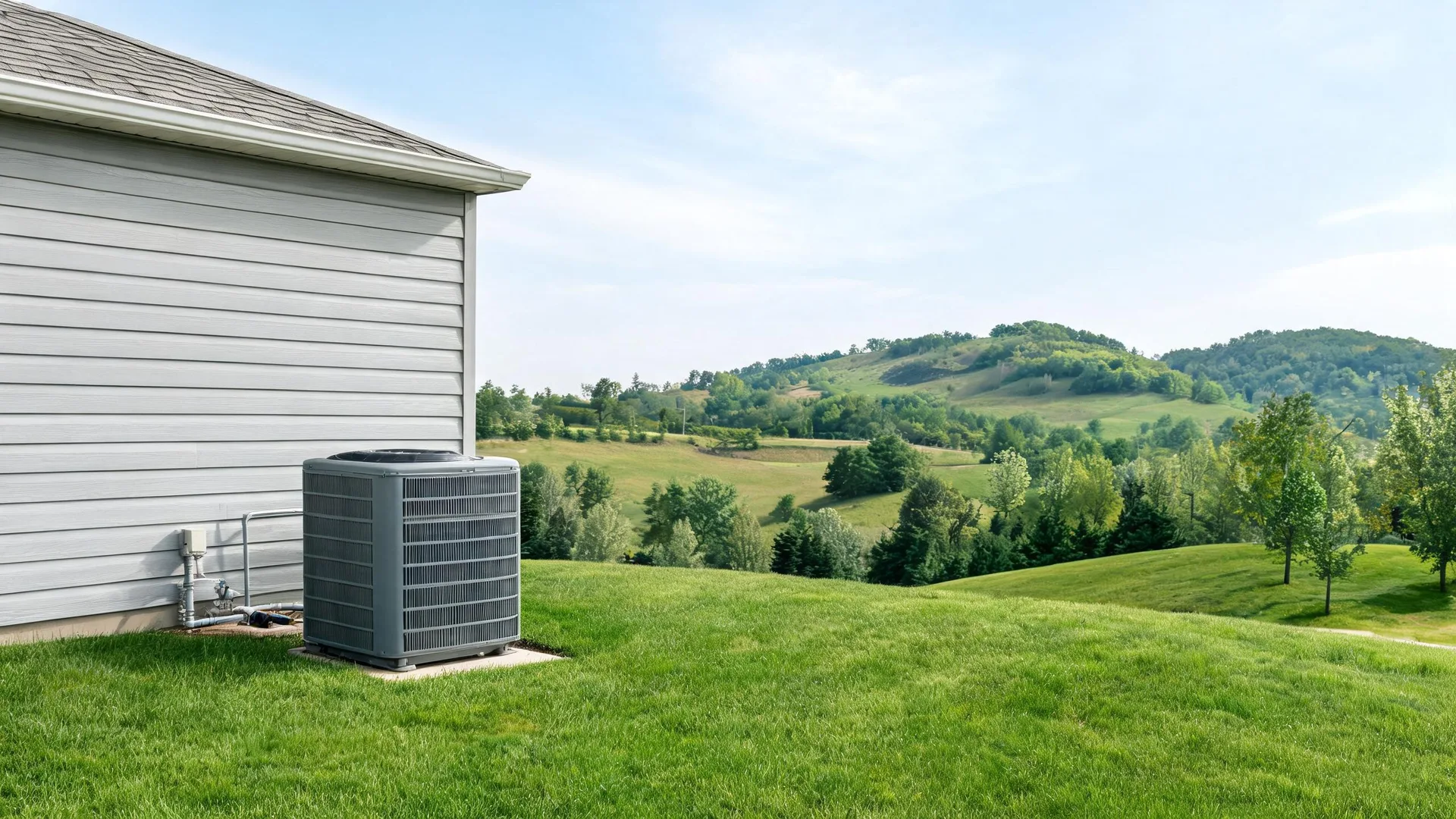
A gray outdoor HVAC unit mounted on a concrete pad beside a house with gray lap siding and a stone foundation.

What's wearing out while the system still seems fine

A heat pump runs on a schedule most homeowners never see. Oil breaks down in a motor bearing over years of cycling. Contacts in the contactor pit and burn a little every time the compressor kicks on. A capacitor loses its charge slowly, holding enough to start the system until the day it doesn't. None of that shows up as a symptom until it fails outright, usually at the worst possible time. A tune-up catches it earlier because someone is actually measuring instead of waiting. Amp draw on a motor that's working harder than it should climbs before the motor quits. A capacitor tested under load shows a weak reading before it drops the system entirely. Refrigerant pressure that's drifted off spec shows up on gauges long before the house feels it. None of these are things you'd notice by looking at the unit or listening to it run. The system keeps working, a little worse each time, until the point it stops.

Skip it and the defrost cycle goes unwatched

A heat pump has to shed frost off the outdoor coil all winter, switching into defrost and back on its own. A failing sensor or control board can leave it stuck, either defrosting too often and robbing you of heat, or not enough until the coil ices solid. Nobody checks that sensor unless they're already out there with the system in hand.

Skip it long enough and the compressor pays for it

A dirty coil or a refrigerant charge that's drifted low makes the compressor work harder to move heat into the house. It doesn't fail right away. It just runs hotter and longer than it should, year after year, and the compressor is the one part in the system that's not worth fixing on its own. By the time it quits, the choice is replacing the whole unit.

Between visits, the main thing worth doing is keeping the filter clean and the outdoor unit clear. A dirty filter chokes airflow across the indoor coil, and a heat pump feels that more than a furnace does because it depends on steady airflow in both heating and cooling. Outside, keep leaves, grass clippings and anything else out of the cabinet, and leave open space around it so air can pull through freely. After a hard freeze, check that the outdoor unit isn't buried in ice that didn't clear on its own during a defrost cycle. Beyond that, leave the refrigerant, the electrical connections and the reversing valve alone. Those need gauges and meters, not a homeowner with a garden hose.

A proper tune-up starts with the nameplate, not a checklist in someone's head. The tech pulls the model's rated refrigerant charge and airflow and checks the system against those numbers, not a generic standard. The indoor coil gets inspected for dirt, since a coated coil loses heat transfer long before it looks dirty enough to worry about. Electrical connections get tightened, because a loose lug heats up under load and that heat damages the wire over time. The condensate line gets checked for a clear path, since a heat pump that's also dehumidifying needs that water to leave the system, not back up into the cabinet. Thermostat calibration gets checked too, because a stat that's reading the room wrong will run the system longer than it needs to, or shut it off too soon.