






White two-story houses with wraparound porches and Spanish moss-draped oak trees photographed along a residential street at night.

Heat Pump Repair in Lafayette, LA

Tell us about the job

Takes about a minute. No obligation.

RepairHeat PumpLafayette Parish, LA
Step 1 of 2

What ZIP code is the job in?

Half the homes in Lafayette Parish were built in 1988 or later. If yours is one of them, the heat pump probably isn't original equipment, or if it is, it hasn't been running long enough to be worn out. A newer system failing isn't usually a sign the whole unit is done. More often it's a single part, like a capacitor or a contactor, giving out while everything else still has life left. That's a repair, not a replacement.

5 months
November through March, your system heats
7 months
April through October, it cools
44°F
the average winter night it heats against
91°F
the average summer afternoon it cools against
Isometric grayscale illustration of a cutaway house showing interior rooms, ceiling ductwork connected to an indoor air handler, and an outdoor condenser unit beside the exterior wall.
Your system heats November through March and cools April through October.

NOAA nClimDiv, 1991–2020 normals

April is when cooling starts here, after a quiet month in March.

A heat pump that sat still through March can show its weak part the first hot week it has to work.

Lafayette sees 68 severe weather events a decade, and nearly half of Louisiana homes lost power for a day or more last year

68 severe weather events from 2015 to 2024
49% of homes statewide lost power a day or more in 2024
39 damaging wind events from 2015 to 2024

Ask for a repair quote first, not a replacement quote. On a newer system, a technician can usually trace the problem to a single part like a capacitor or contactor within minutes, and that's a straightforward fix. If you know the install date, mention it, since it helps the contractor rule out anything related to age before they even arrive. Either way, a failed part on a system that still has years ahead of it is worth fixing, not swapping out.

Had any storms come through? Get the outdoor unit checked, not just the symptom.

If your heat pump has been sitting outside through storm season, hail and debris can mark the coil or bend the fins without stopping it from running. A unit that still turns on isn't the same as one that's fine. Worth having it looked at now, before the next hot stretch asks more of it.

Find a contractor
A man in a cap, dark jacket and tan work pants carries a canvas tote bag as he steps up concrete stairs toward a blue front door, with a potted shrub beside him.
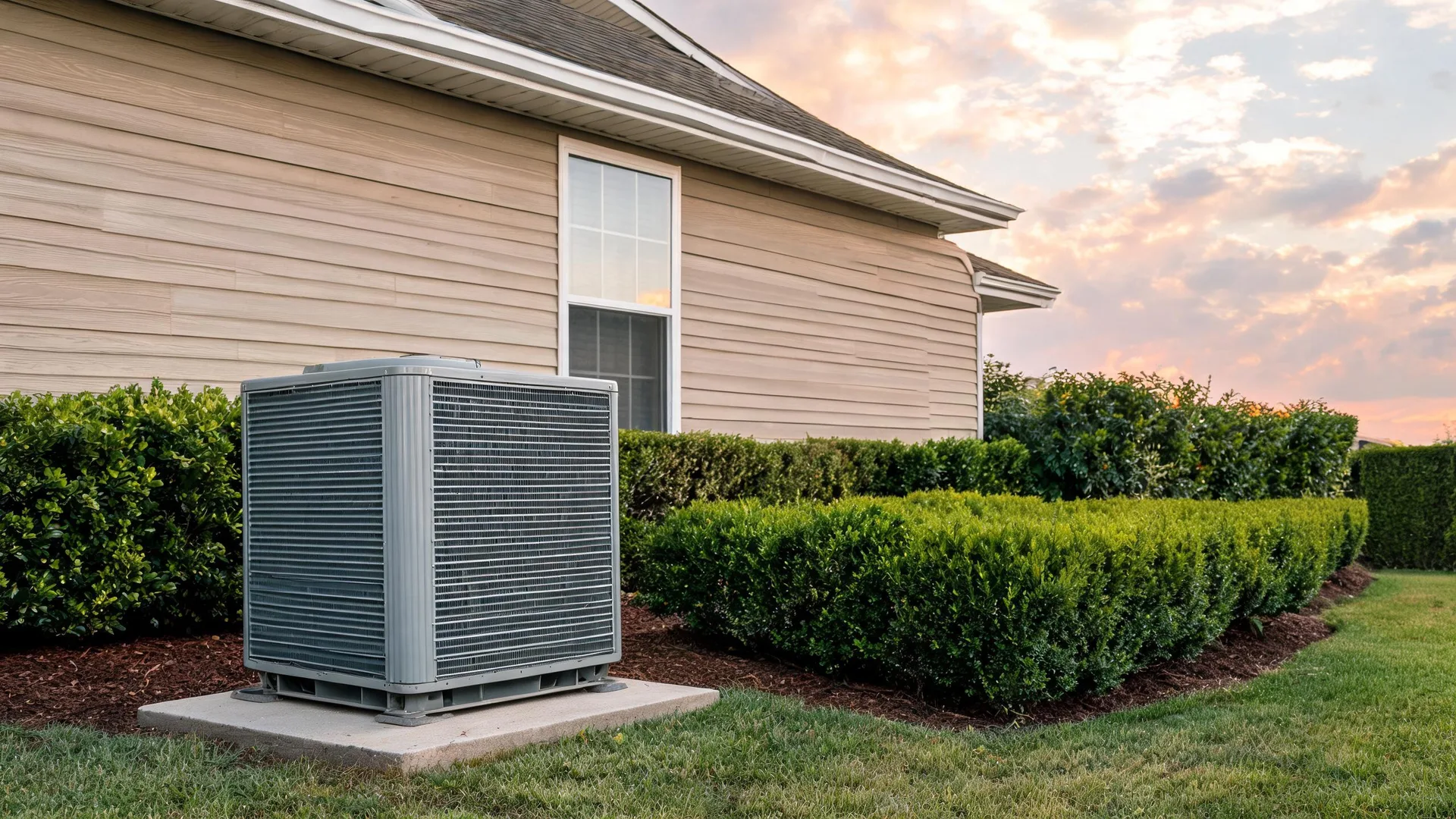
A gray heat pump outdoor unit mounted on a concrete pad next to the stone-accented exterior wall of a house.

What to check yourself first

Before anyone comes out, go outside and look at the unit itself. Check that air moves freely around it, no leaves packed against the coil, no grass clippings or mulch piled against the fins. A heat pump needs open air on all sides to move heat, and if something's blocking it, that alone can make it run weak or short-cycle. Look at the fins for anything crushed flat over a wide area. Go inside and check the thermostat batteries if it uses them, and check the filter. A filter clogged with dust chokes airflow the same way a blocked coil does, and it's the easiest thing to fix yourself. Flip the breaker off and on once if the unit isn't responding at all, but if it trips again right away, stop and leave it off. That's not a reset situation anymore. Listen for what it's doing when it runs. A hum with no fan turning, a click that repeats without the unit starting, or a fan that spins slow and labors, those are all worth mentioning to whoever comes out, because they point at different parts. What you can't check safely is anything behind the panel, the refrigerant charge, or the electrical connections. That's not a knife-and-fork job. Leave it for someone with gauges and a meter.

Most failures are the same few parts

The capacitor gives out the most, since it's working every time the compressor or fan starts and it weakens a little each time. The contactor wears from the arcing every time it closes. Both sit in the outdoor unit and both are a straightforward swap. Refrigerant leaks and a failing compressor happen too, but far less often, and usually after years of the small stuff being ignored.
A small part left bad becomes a big one

A weak capacitor makes the compressor strain to start, and a compressor that strains on every start wears out early. A dirty coil makes the system run longer to do the same job, and that extra runtime is what burns up the parts underneath it. Catching the small failure early is usually what keeps it a small failure.

A heat pump that's struggling doesn't stop and wait to be fixed. It keeps cycling, trying to hit the thermostat setting, and that effort lands on whatever part is already weak. A capacitor that's losing strength still starts the compressor, just harder, and every hard start wears it down further. Low refrigerant doesn't fix itself by running longer. It makes the compressor pull harder to move the same heat, and heat is what kills a compressor over time. A coil that's dirty or iced over forces longer cycles, and that extra runtime falls on the same motor and the same capacitor. The part that failed first is rarely the only one you're replacing if the unit keeps running on it.

A heat pump works in both directions, and that's the part worth understanding before deciding what to fix. A reversing valve is what lets it switch between heating and cooling, and it's a part a plain air conditioner doesn't have. When that valve or the solenoid driving it fails, it usually sticks partway, so the system blows warm air when it should be cold, or the other way around. That's a valve problem, not a compressor problem. A compressor that's actually failing tends to show it in both modes, since it's doing the same work either way. If your system heats fine but won't cool, or cools fine but won't heat, that's worth telling whoever comes out, because it points straight at the part most likely behind it.