Night view of illuminated white Southern-style houses with wraparound porches beneath Spanish moss-draped oak trees.

Heat Pump Installation in Opelousas, LA

Tell us about the job

Takes about a minute. No obligation.

New system or replacementHeat PumpSt. Landry Parish, LA
Step 1 of 2

What ZIP code is the job in?

Wind and tornadoes are the real risk

St. Landry Parish logged 52 damaging wind events and 17 tornadoes in the last decade, far more than hail. A heat pump's outdoor unit should go where it has some cover from flying debris, not out in the open where a fence line or shed can't break the wind.

Plan for the power to go out

Almost half of Louisiana households were without power for a day or more in 2024. A heat pump needs electricity to run, for heat and for cooling both, so if backup power matters to you, that's a conversation to have before installation, not after.

5 months
November through March, your system heats
7 months
April through October, it cools
43°F
the average winter night it heats against
91°F
the average summer afternoon it cools against
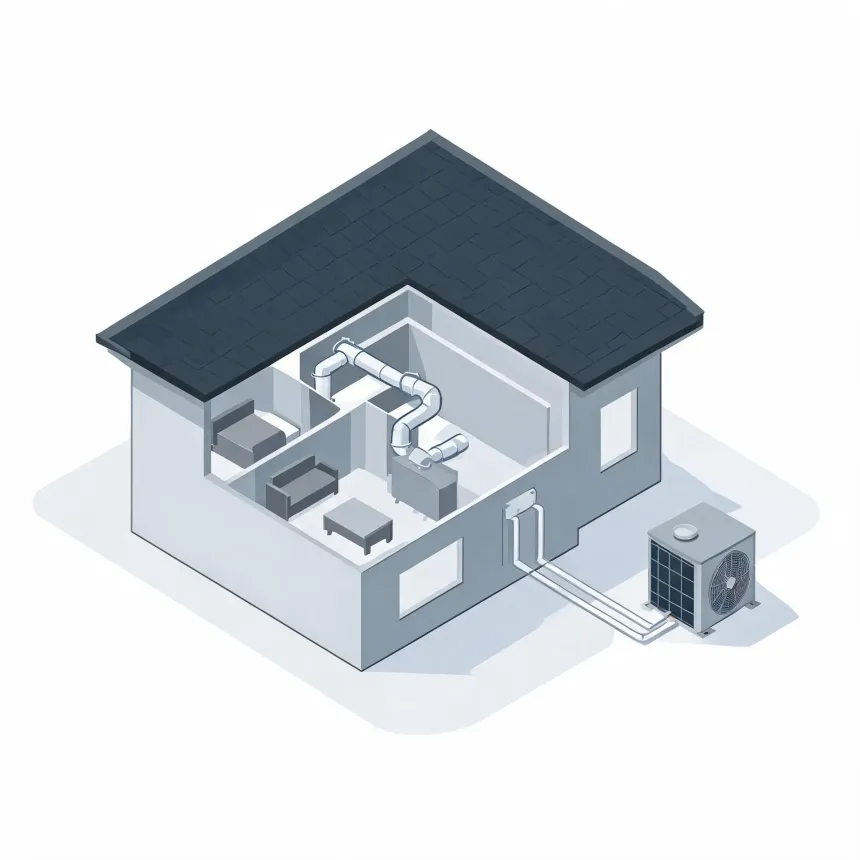
Isometric illustration of a cutaway single-story house showing interior ductwork, an indoor air handler and simple furniture, connected by lines to an outdoor condenser unit beside the building.
Your system heats November through March and cools April through October.

NOAA nClimDiv, 1991–2020 normals

Electricity heats 72.6% of homes in St. Landry Parish.

A heat pump installed in Opelousas runs on the same electric setup most homes here already have.

Electricity here is cheap, so pick the heat pump that will last, not just the one with the best efficiency number

Power costs 11.73 cents a kWh statewide
Climate zone 2A
Cooling runs April through October

A heat pump installed here has to clear 14.3 SEER2 for cooling and 7.5 HSPF2 for heating, the federal minimum for split systems built from 2023 on. St. Landry Parish sits in climate zone 2A, where cooling carries most of the load, so that cooling number matters more here than the heating one. Central air sold on its own has to clear an even higher bar in the Southeast than the rest of the country. These are floors, not targets, and most systems on the market now sit above them. A federal tax credit is available on qualifying equipment, worth checking against whatever system you're comparing.

A standard heat pump, sized right, is the correct call here

Nothing about St. Landry Parish pushes you toward a bigger unit or a higher efficiency tier. Half the homes here were built in 1980 or earlier, half in 1980 or later, and that split doesn't change what size or tier fits. A correctly sized standard system works in either one. What matters is getting the size right for the house you actually have, whether it's a mobile home or site-built, and giving the installer a look at the ductwork and electrical before anything is ordered.

Find a contractor
A white mini-split heat pump outdoor unit mounted on a concrete pad beside a gray-sided house, surrounded by gravel and green shrubs.

The old system's wear doesn't carry over, but its ductwork might

Whatever is coming out, a furnace paired with an AC or an older heat pump, has been cycling on and off for years without a break longer than a season. That wears specific parts. The contactor that switches power to the outdoor unit pits and sticks. The capacitor that gets the compressor started weakens. The blower motor bearings wear down and start making noise. None of that failing history carries over. A new heat pump starts its own clock on its own parts. What's worth checking before the old equipment comes out is the ductwork it's been running through. Ducts sized and sealed for a furnace and AC don't always suit a heat pump, which tends to run longer at lower output instead of short, hot bursts. An installer can look at what's there and tell you if it works as is or needs changes.

The ductwork decides more than the unit does

If the existing ducts are undersized, leaky, or routed poorly, an installer has to fix or replace sections before the heat pump can heat and cool the way it should. That work costs more than the equipment swap itself in some homes and barely registers in others. There's no way to know which case applies until someone's looked at what's actually running through the walls and attic.

Where the outdoor unit sits changes the labor

Running new electrical to a different spot, pouring a pad, or routing line sets around an awkward layout all add work beyond setting the unit down and connecting it. A straightforward swap in the same location with the same electrical panel capacity is the cheapest version of this job. Anything that moves the unit, upgrades the panel, or adds a line set run costs more in labor before the equipment is even factored in.

When you're comparing quotes, ask what each contractor found when they looked at the ductwork, not just what unit they're proposing. A contractor who's actually inspected what's there can tell you whether it needs work before the heat pump goes in. One who hasn't is quoting blind. Ask how they arrived on the size, too. A correctly sized system comes from a load calculation done on your house, not a guess based on the old unit or a rule of thumb. If a number shows up on a quote without anyone having measured anything, ask where it came from. Ask what the warranty covers on labor, not just parts. A compressor replaced under warranty still costs money if nobody's paying for the labor to put it in. And ask what happens to the line set and electrical if the outdoor unit goes somewhere new. That work belongs in the bid whether it's broken out as its own line or folded into the total.

Size comes from a load calculation, a room by room count of how much heat the house gains in summer and loses in winter. It accounts for square footage, but also window area, insulation, ceiling height, and which way the house faces. Homes the same size can need different sized systems because one holds heat better than the other. A unit that's too big cools the air fast and shuts off before it pulls the moisture out, so the house feels cold and damp at once. A unit that's too small runs constantly and still can't keep up on the hottest or coldest days. Either mistake also shortens the life of the compressor, which isn't built to start and stop as often as a wrongly sized unit forces it to. The only way to get the number right is to measure the house that's actually there, not match whatever size came out before.