






Single-story houses with covered porches sit behind a mowed lawn and a long trimmed hedge, framed by oak branches draped with Spanish moss.

Heat Pump Installation in New Iberia, LA

Tell us about the job

Takes about a minute. No obligation.

New system or replacementHeat PumpIberia Parish, LA
Step 1 of 2

What ZIP code is the job in?

Most homes in Iberia Parish heat with electricity, 64.1% of them. Utility gas covers another 33.7%, with bottled or LP gas making up the rest. A heat pump fits right into that electric majority, since it runs on the same fuel most homes already have for heating. For a gas household switching over, it means adding electric capacity where the furnace used to pull from a gas line. Either way, a heat pump also handles cooling, which matters here for most of the year.

5 months
November through March, your system heats
7 months
April through October, it cools
46°F
the average winter night it heats against
90°F
the average summer afternoon it cools against
Isometric line illustration of a cutaway single-story building showing interior rooms, ceiling ductwork, an indoor air handler, and an outdoor condenser unit connected by refrigerant lines.
Your system heats November through March and cools April through October.

NOAA nClimDiv, 1991–2020 normals

Iberia Parish logged 40 severe weather events between 2015 and 2024, most of them wind.

A standard heat pump, installed to code, is built to take that. No need to size up or spend more for this county.

A standard heat pump sized for this home is all this county calls for

Half the homes here were built by 1982
Power costs 11.73 cents a kWh statewide
Climate zone 2A

October is the better time to put in a heat pump here, not November once the cold has already arrived. Homes in Iberia Parish run heat from November through March, then move straight into cooling that lasts from April through October. A heat pump installed in October gets checked out and set up before either load hits it. Wait for a cold snap to force the issue and you're choosing a system in a hurry, maybe living without heat while parts get ordered. Get it in ahead of November and it's already proven itself before summer asks it to cool the house too.

A new heat pump here has to meet zone 2A's efficiency minimum, and there's a federal credit toward it

Any heat pump installed in Iberia Parish now has to hit 14.3 SEER2 for cooling and 7.5 HSPF2 for heating, the federal minimum as of 2023. Zone 2A runs hot and humid most of the year, so the cooling side of that rating is the one doing the work here. A federal tax credit is available toward a qualifying system, on top of meeting that standard.

Find a contractor
A man in a cap and dark jacket, seen from behind, carries a canvas tool bag up porch steps toward a dark blue front door of a gray-sided house.
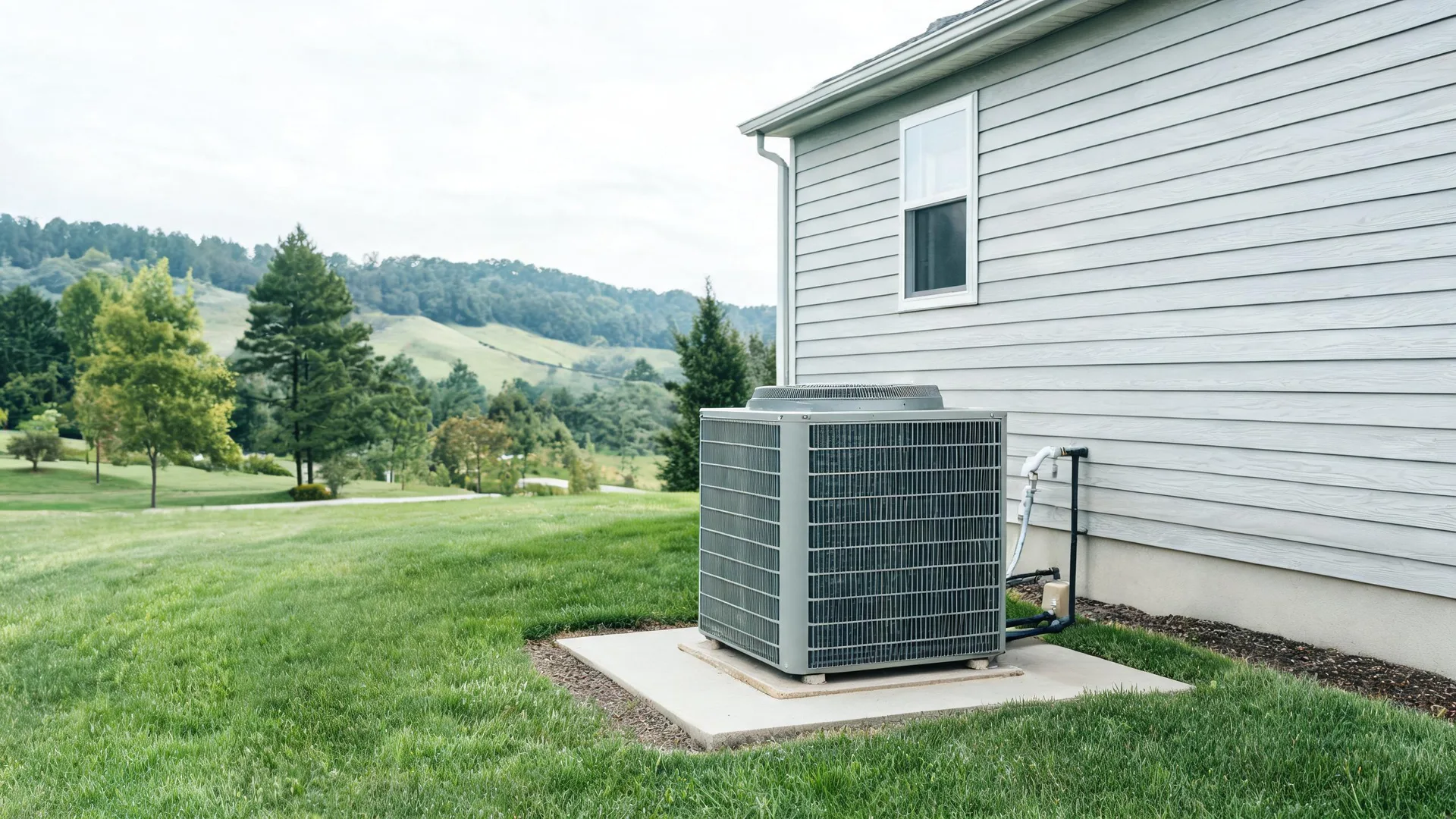
A gray heat pump condenser unit mounted on a concrete pad against the gray lap-siding exterior wall of a house.

Matching the unit to the house, not the other way around

Sizing a heat pump comes down to matching its output to the heat the house gains in summer and loses in winter, not to the square footage on a listing. A contractor works that out room by room, looking at wall and ceiling area, window size and direction, and how much air leaks in and out, then adds it into a single number the equipment has to meet. Go bigger than that number and the unit short cycles, reaching the thermostat setting fast and shutting off before it finishes pulling moisture out of the air, so the house feels cool but clammy. Go smaller and it runs constantly on the hottest and coldest days, struggling to keep up and wearing down the compressor faster than it should. A unit sized correctly runs in long, steady cycles that hold the temperature even and give the system time to do its job properly on each one.

Ask about the defrost cycle

A heat pump pulls heat from outside air, so in cold, damp weather the outdoor coil can frost over. The unit then reverses briefly to melt that frost before going back to heating. Ask how often that happens and what it looks like from inside, since some models handle it with barely a pause and others blow noticeably cool air for a few minutes while they clear the coil.
Ask what happens on the coldest nights

Every heat pump loses some capacity as the outdoor temperature drops, and some models make up for it with backup heat strips that draw more power to hold the house at temperature. Ask at what outdoor temperature the unit you're comparing starts leaning on that backup heat, and how it's controlled. A system that switches over smoothly and rarely needs it is a different machine to live with than one that leans on backup heat most of the winter.

That SEER2 and HSPF2 pair on the label comes from a lab test, not a promise about your house. It's measured with the refrigerant charge exact, the ductwork sealed, and the coil clean, conditions a contractor can get close to but that slip over time without upkeep. Heat pumps carrying the same rating can still perform differently once installed, because the number says nothing about how tight the ductwork is or how carefully the unit was set up on day one. Read the rating as what the equipment is capable of, not what it will deliver. What it actually delivers comes down to whether it was sized right, charged right, and kept up after that.

Installation day starts with the old equipment coming out, not the new unit going in. The line set gets disconnected, the refrigerant recovered, and the pad or mounting bracket checked to see if it still works for the new outdoor unit or needs replacing. Indoors, the air handler or coil goes in, and the electrical gets matched to what the new system draws, which often isn't what the old one drew. The line set gets pressure tested for leaks before any refrigerant goes in. Once that holds, the system gets charged to the exact weight the manufacturer specifies for that length of line. Then comes the startup check, airflow at the vents, temperature split across the coil, the thermostat talking to the system the way it should. A heat pump that's wired and charged correctly runs quietly from the first cycle, nothing to break in or settle over time.