






Two illuminated white colonial-style houses with wrap-around porches, flanked by oak trees draped in Spanish moss, photographed at night.

Heat Pump Installation in Bogalusa, LA

Tell us about the job

Takes about a minute. No obligation.

New system or replacementHeat PumpWashington Parish, LA
Step 1 of 2

What ZIP code is the job in?

Most homes in Washington Parish heat with electricity, close to seven in ten. A heat pump fits right into that setup, since it runs on the same power your current system already uses. Gas heats a smaller share here, about one in five homes. If your house is part of that electric majority, swapping in a heat pump means no new fuel line and no change to how the house is set up, just a different kind of electric system doing the work.

5 months
November through March, your system heats
6 months
May through October, it cools
41°F
the average winter night it heats against
91°F
the average summer afternoon it cools against
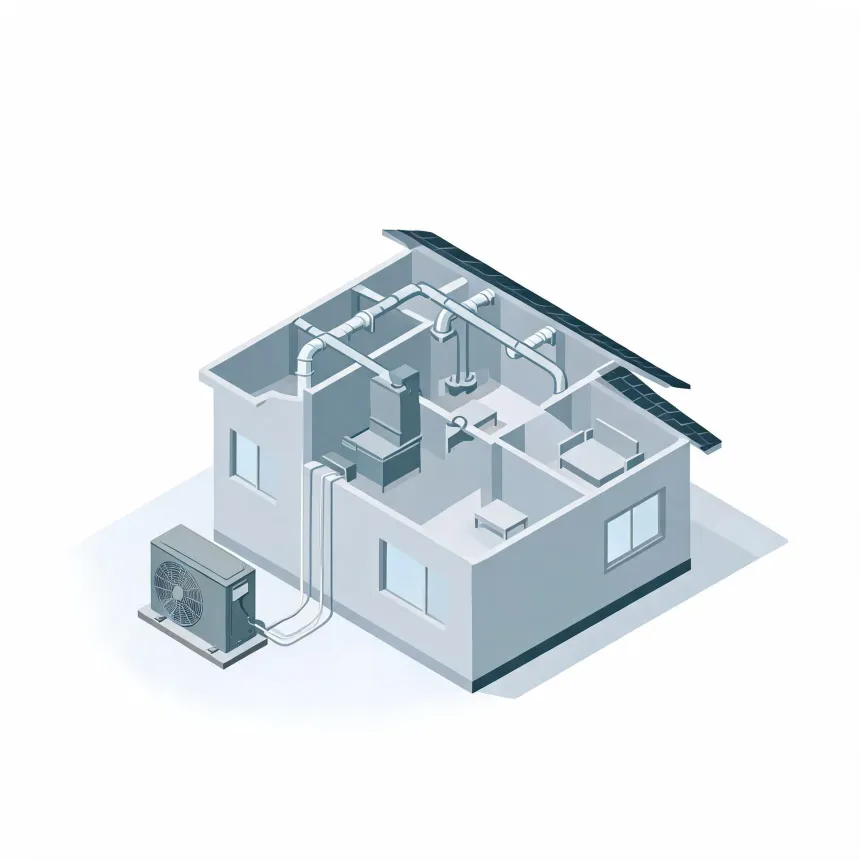
Isometric cutaway illustration of a single-story house showing interior ductwork, an air handler and rooms, with an outdoor condenser unit connected by refrigerant lines on a plain white background.
Your system heats November through March and cools May through October.

NOAA nClimDiv, 1991–2020 normals

Louisiana power ran 11.73 cents a kilowatt-hour in 2024, cheap next to most of the country.

The highest-efficiency heat pump on the shelf will take longer to earn back its price here, so pick one for how it holds up, not just its rating.

A standard heat pump fits here, same as it does anywhere in zone 2A

Half the homes here were built by 1982
Power costs 11.73 cents a kWh statewide
Climate zone 2A
A standard heat pump handles this parish fine38 severe weather events hit Washington Parish between 2015 and 2024, mostly wind, none of it calls for bigger equipment.

Bogalusa sits in climate zone 2A, where cooling carries most of the load. Any split-system heat pump installed new has to meet 14.3 SEER2 and 7.5 HSPF2 at minimum, and the central air equipment sold alongside it in the Southeast has to clear that same 14.3 SEER2 mark below 45,000 Btu/h, a higher bar than what manufacturers meet for the rest of the country. That narrows what a contractor can offer you, in a good way. You're not choosing between a strong unit and a weak one, since the weak ones aren't legal to install here. The choice comes down to how a system holds up and how it's sized for your house, not whether it clears the regional minimum.

Install before April or October, not after

Cooling runs May through October here. Heat runs November through March. April gives you a line to install before the cooling months start, October before heat season does. Get a heat pump in ahead of one of those and it starts the season already running, instead of catching up to one.

Find a contractor
A man in a cap, dark shirt and tan work pants walks up porch steps toward a gray front door, carrying a canvas tool bag, with a potted plant on the porch to the right.
A gray heat pump outdoor unit mounted on a concrete pad next to the stone-accented exterior wall of a house.

The old equipment comes out, the ducts stay put

Whatever's running now doesn't get shut off and dragged to the curb the same day. A contractor disconnects the refrigerant lines and the power, then pulls the indoor and outdoor units separately. If the old system runs on a gas furnace paired with an AC coil, the furnace usually comes out too, since a heat pump takes over both jobs and doesn't need it sitting there. The refrigerant left in the old lines gets recovered, not vented, that's a legal requirement, not a courtesy. Copper lines and the old pad often get reused if they're still in good shape. Whatever gets hauled off, the metal in it gets recycled rather than landfilled, since there's real scrap value in the coils and the compressor. None of this touches your ductwork. A heat pump ties into the same supply and return lines the old system used, so the parts of your house that moved the air stay exactly as they were.

Ask what size load calculation they ran

A heat pump sized off square footage alone can end up too big or too small for the house. A proper load calculation looks at insulation, windows, and ceiling height room by room. Oversized equipment cycles on and off fast and never runs long enough to pull moisture out of the air. Undersized equipment runs constantly and still can't keep up on the coldest or hottest days. Ask to see the numbers, not just hear a square footage guess.
Ask how they're handling the switch from gas heat

If the house is moving off a gas furnace, the heat pump has to cover the full heating load on its own, not just supplement it. Some systems pair the heat pump with electric strip heat for the coldest stretches, which costs more to run than the heat pump itself. Ask whether the unit they're proposing is sized to carry the house without leaning on that backup heat most winters.

Sizing a heat pump isn't about matching tonnage to square footage. Houses that look the same from the street can need different equipment depending on how much glass they have, which way the windows face, how much air leaks in around doors and the attic hatch, and what's in the walls. A contractor works this out room by room with a load calculation, weighing all of that against the local design temperature, not just counting square feet and picking a number off a chart. Get the size wrong and it shows up both directions. Too big, and the unit blasts the house to temperature and shuts off before it's run long enough to pull humidity out of the air, so it feels clammy even when the thermostat says it's satisfied. Too small, and it runs flat out on the hottest and coldest days and still can't keep up, leaning on backup heat more than it should. The right size runs long steady cycles most days and only calls on backup heat when the weather is genuinely extreme.

Install day itself usually runs one day for a straightforward swap, longer if the ductwork needs changes or the electrical panel needs work to handle the new unit. The crew sets the outdoor unit on a pad first, then runs new refrigerant lines if the old ones aren't being reused. Inside, the air handler or coil goes in wherever the old one sat. Once both ends are connected, the lines get pressure tested for leaks before any refrigerant goes in, then evacuated to pull out moisture and air that would otherwise wreck the system's efficiency. The electrical hookup comes next, tying the outdoor unit to its own circuit and setting the thermostat to talk to the new equipment. Last comes startup and testing, running the system in both heating and cooling to check refrigerant charge, airflow at the vents, and that the thermostat is controlling things the way it should.